
- DesignSpark PCBのウィンドウ構成や作図の基本操作
DesignSpark PCBを学ぶ
DesignSpark PCB ソフトウェア明確 の使用方法を理解します。で詳細なチュートリアルをご覧ください。 シンプルで論理的なワークフローに従って、有益な情報を取り入れながら詳細を学ぶことができます。
学習をサポートするために、他のリソースを利用すると役立つ場合があります。 弊社には専用のフォーラムがあり、 記事を参照してください。 さらにサポートが必要な場合は、よくある質問ページをご覧ください。
こちらのチュートリアルで以下の事を学べます。
- 新規に回路図を作成し、そこから基板レイアウトを編集する手順
- 回路シンボルやフットプリント等の部品ライブラリを管理方法
- DRC:デザインルールチェック(基板製造上の問題点を抽出)の使い方
チュートリアル
初級、中級、上級と段階的にDesignSpark PCBを学べるチュートリアルです。
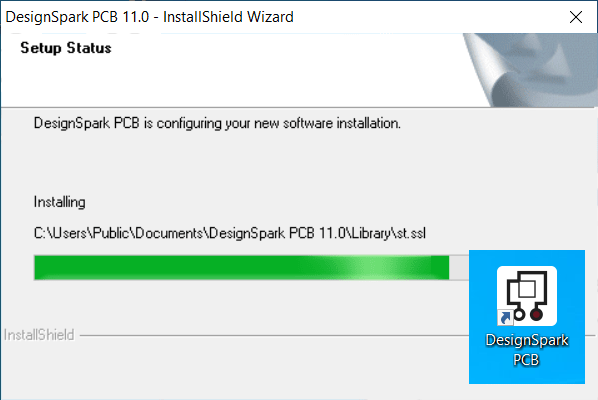
DSPCBのセットアップ
ソフトウェアのダウンロード、インストール、アクティベーションの方法を学びます
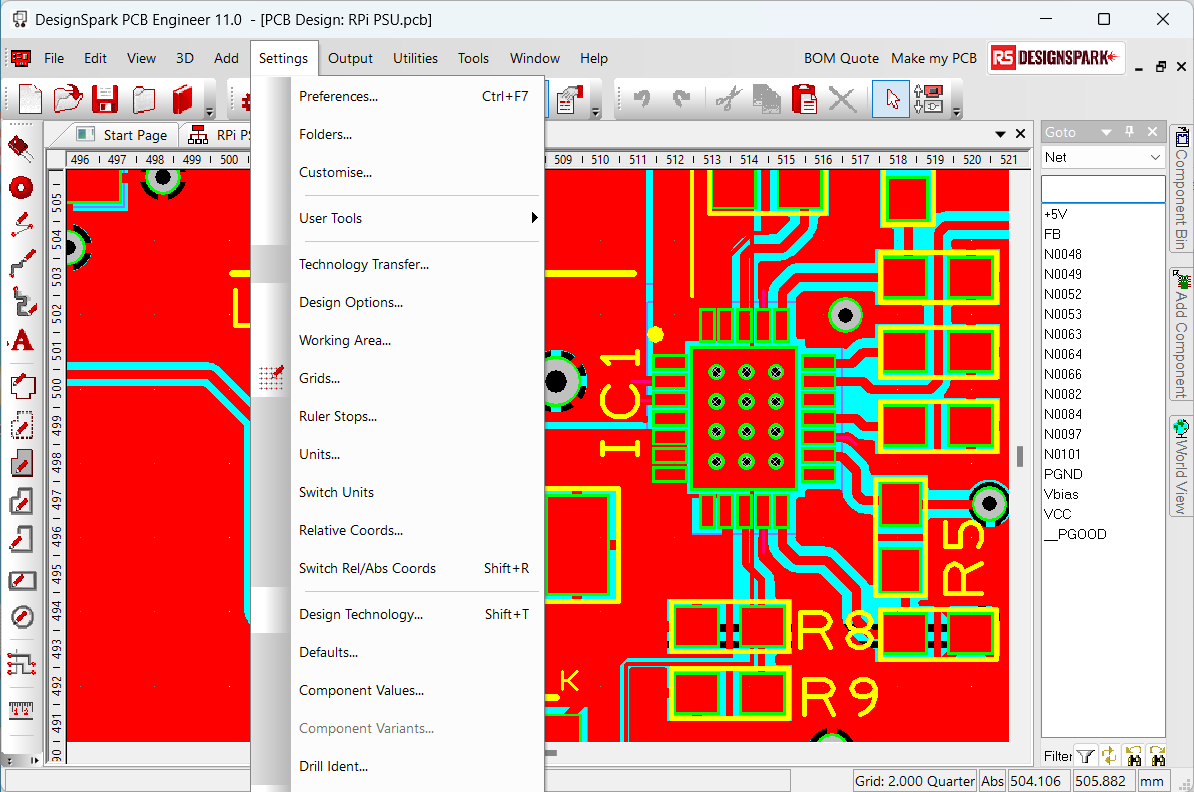
DSPCBのインターフェース
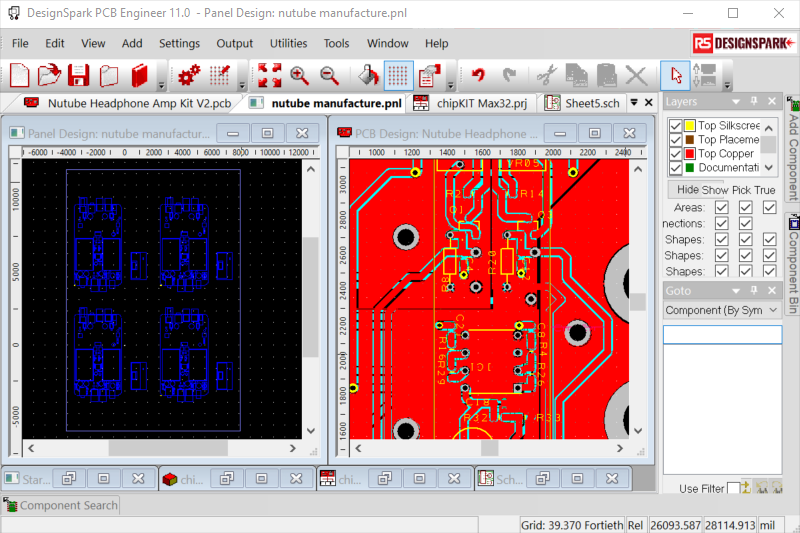
DSPCBのインターフェースや基本操作を学びます
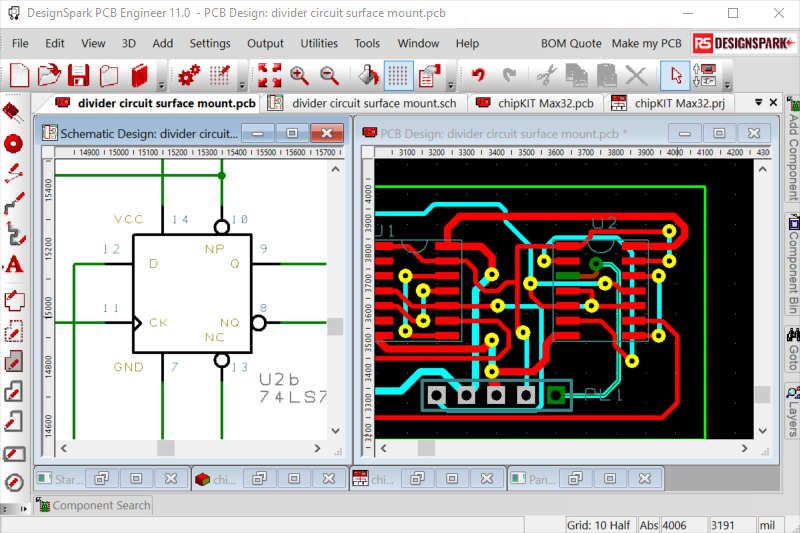
プロジェクトファイルを新規に作成
回路図から基板配線図の作成まで、新規に基板設計を初める場合の新規ファイル作成方法を学びます

コンポーネントライブラリの活用
コンポーネントライブラリ(基板CADライブラリ)の仕組みや作成方法について学びます
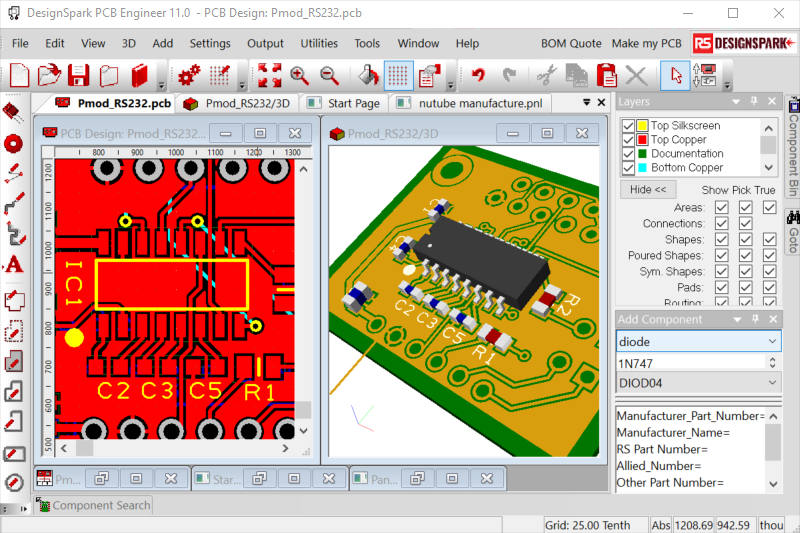
オリジナル基板を設計
オリジナルの自作基板の設計する方法を学びます
基板製造データ出力
自作した基板の製造用データの出力方法を学びます。
PCB バージョン 12 - 新機能チュートリアル
PCB編集画面でのコンポーネントビンの使い方、フィルタリングなどを教えてください。
計測値を複数の単位系で表示させることはできますか?
既存のPCBファイルを雛形に新規に基板設計できますか?
基板製造ファイルの出力前のチェック機能について
プロジェクトの部品をまとめて保存できますか?
プロジェクト内のファイルを単体でコピー保存する方法(Save As Copy)
回路図での部品の端子名に連番付きピン名を作成するには?
自作のライブラリを回路図やフットプリントごとまとめてエクスポートする方法

複数ライセンス利用の際の煩わしさを解決!
マルチシートライセンスなら、開発チームのライセンス管理が容易になります。
- メンバーの増減・異動・担当変更に合わせ、ライセンスの割り当てをユーザ側で柔軟に変更可能
- メンバー全員が3種の設計ツールを利用
- シート数が増えるほど割引率アップ
DesignSpark PCBのコミュニティ
DesignSpark PCBのユーザと相談できるコミュニティーです。多言語混在コミュニティーなので日本語でも投稿頂けます。
Hi,
Many production companies need to have the Board size also as part of a BoM. This helps in multiple ways such as
Collecting the PCB in addition to the components in the Production bins.
Early Ensuring that the correct PCB is being used for production.
The DesignSpark PCB editor already contains the Board and its size in the units chosen. So whenever a BoM (Bill of Materials) or rsbom is created from the PCB editor, it hsoudl be possible for the tool to add a line of PCB with its size etc to the BoM. Shapes may be given as square, recatangle, triangle, circule or custom, depending upon the type of PCB used.This would be a of Great help to design teams that finally offload details to production departments and production service companies.Best Regards,Vishal Sapre Bonjour,
J'essaie d'installer DesignSpark PCB 13.0.3 sur Windows 11, mais le logiciel refuse de démarrer.
Le message d'erreur indique :
« Init.dll n'est pas conçu pour s'exécuter sous Windows ou il contient une erreur. État de l'erreur : 0xc0e90002. »
Après vérification dans l'Observateur d'événements Windows, j'ai constaté un événement CodeIntegrity 3077 indiquant que "DesignSpark.exe" tente de charger "Init.dll", mais que le fichier ne respecte pas les exigences de signature de la stratégie de sécurité.
Le fichier "Init.dll" affiche la version 29.0.4.2 et ne présente aucune signature numérique dans ses propriétés. Smart App Control est activé sur mon PC.
J'ai déjà réinstallé le logiciel à partir de l'installateur officiel "DesignSparkPCB_V13_0_3", dont la version du fichier est 13.0.3002.0, sans résoudre le problème.
Pourriez-vous m'indiquer comment faire fonctionner cette version sous Windows 11 avec Smart App Control activé, ou me fournir un correctif officiel ?
Merci pour votre aide.
----------------------------------------------------
Good morning,
I am trying to install DesignSpark PCB 13.0.3 on Windows 11, but the software refuses to start.
The error message reads:
"Init.dll is either not designed to run on Windows or it contains an error. Error status: 0xc0e90002."
After checking in the Windows Event Viewer, I found a CodeIntegrity 3077 event indicating that "DesignSpark.exe" is attempting to load "Init.dll", but the file does not meet the security policy signing requirements.
The "Init.dll" file displays version 29.0.4.2 and has no digital signature in its properties. Smart App Control is enabled on my PC.
I have already reinstalled the software from the official installer "DesignSparkPCB_V13_0_3", whose file version is 13.0.3002.0, without resolving the problem.
Could you tell me how to get this version working under Windows 11 with Smart App Control enabled, or provide me with an official patch?
Thank you for your help. Hi everyone,
I'm a beginner in PCB design, and honestly, I'm finding it a bit harder than I expected!
I'm trying to understand things like component placement, routing traces, choosing the right number of layers, and making sure the board will actually work when manufactured. There seem to be so many things to consider, and I'm not always sure what I should focus on first.
I'd love to hear about your own experiences, especially anything you wish you'd known when you first started designing PCBs.
Thanks in advance for any advice! When designing a PCB, we usually focus on component placement, routing, trace width, clearances, and signal integrity. But what about solder mask color? Does it make any practical difference in inspection, assembly, or long-term maintenance, or is it mainly an aesthetic choice?
Green is still a common choice for production boards, but black, blue, red, and white solder masks are also widely seen in different applications. For example, black can give a product a clean appearance, while white can be useful for LED boards because of its reflective surface. On the other hand, darker solder masks may make some solder joints or defects harder to spot during visual inspection.
I was looking into the practical differences between these options and came across some discussions of PCB manufacturing requirements, including the color options offered by manufacturers such as PCBCool.
I'm curious about what other engineers have experienced in actual projects.
Have you noticed any meaningful difference in visual inspection when working with different solder mask colors?
Do you consider solder mask color during the initial PCB design stage, or decide it later based on the product enclosure and appearance?
Have you encountered any manufacturing, cost, or lead-time differences when choosing a non-standard color?
I'd be interested to hear your experiences, particularly from people who have designed and manufactured boards in production quantities. Are there situations where you'd strongly recommend one color over another? I have encountered a Catch 22 situation a number of times.
Here is a simple example that illustrates the problem:-
Create a schematic with two resistors and connect them together with a single net: N0001
Translate the schematic to a PCB.
Rename the Net on the PCB from N0001 to N0002
Rename the Net on the Schematic from N0001 to N0003
Now try and forward the design change to the PCB.
If you try to run Back Annotation as suggested it fails with the following error:-
===
Back Annotate renames from the PCB design to all Schematic designs in project "Test1".
Error: Could not find Net " N0001".
===
You are now completely stuck.
If you manually change N0002 on the PCB to match the Schematic (i.e. N0003) this is what happens:-.
However if you now try to forward design changes from the Schematic you get this:-
Attempting Back annotation again gives another error:-
===
Back Annotate renames from the PCB design to all Schematic designs in project "Test1".
Error: Could not find Net " N0001".Error: Could not find Net " N0002".
===
For those old enough to remember the Colossal Cave adventure program: "You are in a maze of twisty passageways , all alike". There is no way out.
In this simple example with multiple renames, the user can eventually find a way out by manually trying to match the Schematic and PCB. In a more realistic example it becomes a nightmare.
What is needed is to allow the user the option to override the Back Annotation requirement and force renames made to the Schematic to the PCB.
You get similar problems if some components on the PCB have newer or older versions compared with those on the Schematic (or vice-versa). It is often unclear whether the user needs to update the component on the PCB or the Schematic. I have found that updating components can have unexpected side effects such as Values dissappearing from the Schematic. DesignSpark PCB stores all PCB geometry using an internal resolution of 0.1 µm, ensuring precision for modern electronics, including fine-pitch BGAs and miniature surface-mount components. Switching between metric and imperial units affects only data entry and display, not design accuracy.
The software uses integer-based calculations to avoid rounding errors during design operations. Metric values provide maximum precision, while imperial dimensions are exact down to 1 thou, with only negligible rounding for fractional-thou values. This precision applies to tracks, pads, vias, masks, and spacing. Advanced features such as Pad Style Exceptions help designers optimize footprints for high-density and advanced PCB applications.
https://www.rs-online.com/designspark/understanding-precision-in-designspark-pcb
After some while i started again with designspark. for unknown part i was transferred to PCB Part Libraries. i can find what i need, but on each library they are asking for username password. Is that the designspark password and username, or a account created by the underlying parties. i seemes not be able to log in on all off the three parties. I get email or account allready exis, but no password or nam/email seems to get mee logged in I have upgraded my designspark license to engineer.
I removed the existing software from my PC
Re isntalled designsparck PCB v13.0.3#
when i log back is software still reports explorer
i select help , reset license , this signs me out when i sign back in it still reports engineer
I have a project that needs 6 audio jacks (3.5mm).So I am on the hunt for a nut driver (that fits the weird shape0 to tighen the mounting nut.
Does any one there know where I can get such animail? Very occassionally I find the DSPCB icon is missing and substituted by a grey box.This just occured when I updated to latest v13.0.3 on one of my systems.
As the icons are contained within the DesignSpark.exe file, you can restore the icon simply by right-clicking on the desktop shortcut and selecting Properties.Then select the Shorcut tab and click the "Change Icon" button.
In the new form, select "Browse" and navigate to the installation folder and select the DesignSpark.exe file.
Select the icon and all is restored.
updated to v13.0.3
Password not working, lost password. Where is the password reminder located I am using DesignSpark PCB Creator 13.0.2 on Windows 11.
I am trying to use the Align function to align multiple components, but all Align commands are always greyed out.
I can reproduce the issue even in a completely new PCB design containing only two resistor components.
Steps to reproduce:
Create a new PCB design.
Place two resistor components.
Make sure the editor is in Select Mode.
Left-click the first component to select it as the master/reference item.
Hold Ctrl and left-click the second component to add it to the selection.
The status bar correctly shows "Multiple Items".
Open Edit → Align.
However, Left, Center, Right, Top, Middle and Bottom are all greyed out. "By Pins" and "By Edges" are also unavailable.
The built-in Help for "Align" says:
"The Align functions on the Edit menu allow several selected design items to be lined up using one of their sides as alignment (left, right, top or bottom)."
It also states that:
"These tools can be used in all design and library editor applications"
and specifically describes aligning components using "By Pins" or "By Edges".
I have also tested this in a completely new PCB, so the problem does not appear to be related to my existing PCB design.
Environment:DesignSpark PCB Creator 13.0.2Windows 11Subscription: Creator
Is the Align function intentionally unavailable with the Creator subscription, or is this a bug in DesignSpark PCB 13.0.2?
If Align is available in Creator, could you please explain what condition is required to enable these commands? I am using DS11 to re-visit a legacy project created in 2017.
I think the original libraries were from DS PCB 7
After making some benign drawing changes to the schematic (no changes to components), I ran the Schematic/PCB Check.
It forced me to run a Back Annotation with the following results:-
===
Back Annotate renames from the PCB design to all Schematic designs in project "1 kHz LP Filter 2".
Change Value on Component 'C4' - 'Value'. - 1 kHz LP Filter 2 v1.schChange Value on Component 'C5' - 'Value'. - 1 kHz LP Filter 2 v1.schChange Value on Component 'C6' - 'Value'. - 1 kHz LP Filter 2 v1.schChange Value on Component 'C7' - 'Value'. - 1 kHz LP Filter 2 v1.schChange Value on Component 'C8' - 'Value'. - 1 kHz LP Filter 2 v1.schChange Value on Component 'C9' - 'Value'. - 1 kHz LP Filter 2 v1.schChange Value on Component 'C10' - 'Value'. - 1 kHz LP Filter 2 v1.schChange Value on Component 'C11' - 'Value'. - 1 kHz LP Filter 2 v1.schChange Value on Component 'C12' - 'Value'. - 1 kHz LP Filter 2 v1.schChange Value on Component 'C13' - 'Value'. - 1 kHz LP Filter 2 v1.schChange Value on Component 'C14' - 'Value'. - 1 kHz LP Filter 2 v1.schChange Value on Component 'C15' - 'Value'. - 1 kHz LP Filter 2 v1.schChange Value on Component 'C16' - 'Value'. - 1 kHz LP Filter 2 v1.schChange Value on Component 'C17' - 'Value'. - 1 kHz LP Filter 2 v1.schChange Value on Component 'C18' - 'Value'. - 1 kHz LP Filter 2 v1.schChange Value on Component 'C19' - 'Value'. - 1 kHz LP Filter 2 v1.schChange Value on Component 'C20' - 'Value'. - 1 kHz LP Filter 2 v1.schChange Value on Component 'C21' - 'Value'. - 1 kHz LP Filter 2 v1.schChange Value on Component 'C22' - 'Value'. - 1 kHz LP Filter 2 v1.schChange Value on Component 'C23' - 'Value'. - 1 kHz LP Filter 2 v1.schChange Value on Component 'C24' - 'Value'. - 1 kHz LP Filter 2 v1.schChange Value on Component 'C25' - 'Value'. - 1 kHz LP Filter 2 v1.schChange Value on Component 'C27' - 'Value'. - 1 kHz LP Filter 2 v1.schChange Value on Component 'C26' - 'Value'. - 1 kHz LP Filter 2 v1.schChange Value on Component 'C28' - 'Value'. - 1 kHz LP Filter 2 v1.schChange Value on Component 'C29' - 'Value'. - 1 kHz LP Filter 2 v1.sch
===
When I ran the Schematic/PCB Check again, it came up with 26 errors, all relating to the same component:-
The Report indicated:-
===
Checking integrity of Schematic and Pcb designs in project "1 kHz LP Filter 2"==============================================================================
Use Update to reload Component "Capacitor_1" to add/alter Value "Value"Use Update to reload Component "Capacitor_1" to add/alter Value "Value"Use Update to reload Component "Capacitor_1" to add/alter Value "Value"Use Update to reload Component "Capacitor_1" to add/alter Value "Value"Use Update to reload Component "Capacitor_1" to add/alter Value "Value"Use Update to reload Component "Capacitor_1" to add/alter Value "Value"Use Update to reload Component "Capacitor_1" to add/alter Value "Value"Use Update to reload Component "Capacitor_1" to add/alter Value "Value"Use Update to reload Component "Capacitor_1" to add/alter Value "Value"Use Update to reload Component "Capacitor_1" to add/alter Value "Value"Use Update to reload Component "Capacitor_1" to add/alter Value "Value"Use Update to reload Component "Capacitor_1" to add/alter Value "Value"Use Update to reload Component "Capacitor_1" to add/alter Value "Value"Use Update to reload Component "Capacitor_1" to add/alter Value "Value"Use Update to reload Component "Capacitor_1" to add/alter Value "Value"Use Update to reload Component "Capacitor_1" to add/alter Value "Value"Use Update to reload Component "Capacitor_1" to add/alter Value "Value"Use Update to reload Component "Capacitor_1" to add/alter Value "Value"Use Update to reload Component "Capacitor_1" to add/alter Value "Value"Use Update to reload Component "Capacitor_1" to add/alter Value "Value"Use Update to reload Component "Capacitor_1" to add/alter Value "Value"Use Update to reload Component "Capacitor_1" to add/alter Value "Value"Use Update to reload Component "Capacitor_1" to add/alter Value "Value"Use Update to reload Component "Capacitor_1" to add/alter Value "Value"Use Update to reload Component "Capacitor_1" to add/alter Value "Value"Use Update to reload Component "Capacitor_1" to add/alter Value "Value"The designs are the same.
===
When I tried to use Update as suggested, it removed the capacitor values on all instances of that component from the schematic.
This is despite checking 'Keep existing component values' in the Update Components diaglog box:-
I could find no way to prevent this from happening.
I ended up having to re-add the component values to the schematic for all 26 capacitors.
I am baffled. What is going on here and what do I need to do to avoid this problem?
Hi
Does anybody know how to remove the component terminal crosses when I copy an old schematic into V13. I've tried deleting the connection and adding but the connection terminal cross still remains.
I've searched the forum and every menu but can't seem to find an option to change it.
If I create a new schematic it works as intended i.e. shows the cross until connected.
When Copied
Original Version I have designed a small double side PCB and used Via with 0.9mm pad and 0.5mm hole size. When the gerber file was loaded and checked DFM, a flag as "Missing plated through hole' flag in DFM check." has been raised . The property of Vias show the above sizes and 'plated' box is checked. I seek help from experts please.
Feature Request for adding PCB and its size in BoM generated from PCB Editor.
Installation PCB 13.0.3 windows 11 erreur
PCB Design Seems Hard for a Beginner. Any Advice?
Choosing PCB Solder Mask Colors: Does It Matter Beyond Appearance?
Back Annotation & Forward Design Changes : Catch 22
Is DesignSpark PCB suitable for these latest small components?
problems accessing rs-online PCB Part Libraries
Upgraded to Engineer but software still Explorer
Looking For A Not Driver Tool
Restoring a missing DSPCB Icon for the desktop or task bar .
lost password
Align commands are always greyed out in DesignSpark PCB Creator 13.0.2
'Update Component' deletes existing values from schematic
Copied Schematic still has connection terminal crosses
"Missing plated through hole' flag in DFM check."
よくある質問
DesignSpark PCBは無料で使えますか?
はい。デフォルトのExplorerプランの場合、無料でご利用頂けます。回路図シート枚数、基板のサイズやレイヤ数、製造出力などに制限はなく、追加料金も発生しません。ちなみに有料のCreatorプランやEngineerプランでは、非貫通ビアへの対応、BOMコンポーザー、SnapEDAとのライブラリ連携、差動ペア配線、DRC機能の拡張といった上位機能を利用頂けます。
このチュートリアルはどのような人を対象としていますか?
DesignSpark PCBの使い方を学ぶ全ての方を対象としています。基板設計やCADの初心者はもちろん、DesignSpark PCBの基本操作を学習したい人や、他社製CADで数多くの基板設計の経験のある方まで、幅広い内容を網羅しています。
このチュートリアルではどのような事を学べますか?
DesignSpark PCBのセットアップ、操作画面の見方や基本操作、回路図作成と基板レイアウト編集、部品ライブラリの作編集、デザインルールチェック(DRC)、製造用Gerberファイルの生成まで、基板設計の一連のワークフローを学べます。
Explorerプラン、Creatorプラン、Engineerプランの違いは何ですか?
Explorerプランでは基板設計の基本機能を無料で利用できます(商用利用も可)。有料のCreatorプランでは、BOM Composer、SnapEDAコンポーネントライブラリ、高度なDRC機能といった拡張機能が利用できるようになります。もう一つの有料プランのEngineerではさらに、ミアンダ配線(Serpentine Routing)、回路図の階層化、非貫通ビア対応、IPC-2581出力など、プロフェッショナルな機能が利用できるようになります。