

Understanding Display Timing Parameters
Display timing parameters are integral to operating Midas LCD TFT Displays, particularly those utilizing interfaces like LVDS (Low Voltage Differential Signaling), RGB, MIPI (Mobile Industry Processor Interface), and eDP (Embedded DisplayPort). These parameters ensure seamless synchronization and reliable data exchange between the display driver and the panel. Here’s why they matter:
- Accurate Image Rendering: Improper timing can cause image distortion, flickering, or complete display failure.
- Synchronization: Proper parameters align the display controller with the panel, avoiding data corruption or loss.
- Energy Efficiency: Optimized timing can contribute to reduced power consumption.
- Compatibility: Different display technologies have unique timing requirements, so using appropriate parameters is essential.
Sources for Display Timing Parameters
To set up a display correctly, it’s vital to reference these key resources:
-
Display Datasheet: This is the primary reference, providing all necessary timing specifications.
-
Display Controller Documentation: Often, the controller’s datasheet outlines supported display modes and their timing requirements. Use this in tandem with the display’s datasheet for accurate configuration.
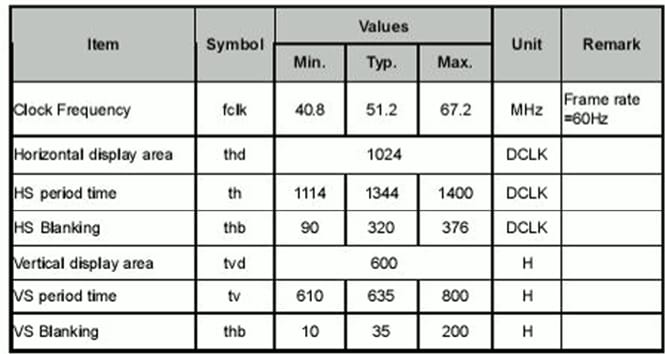
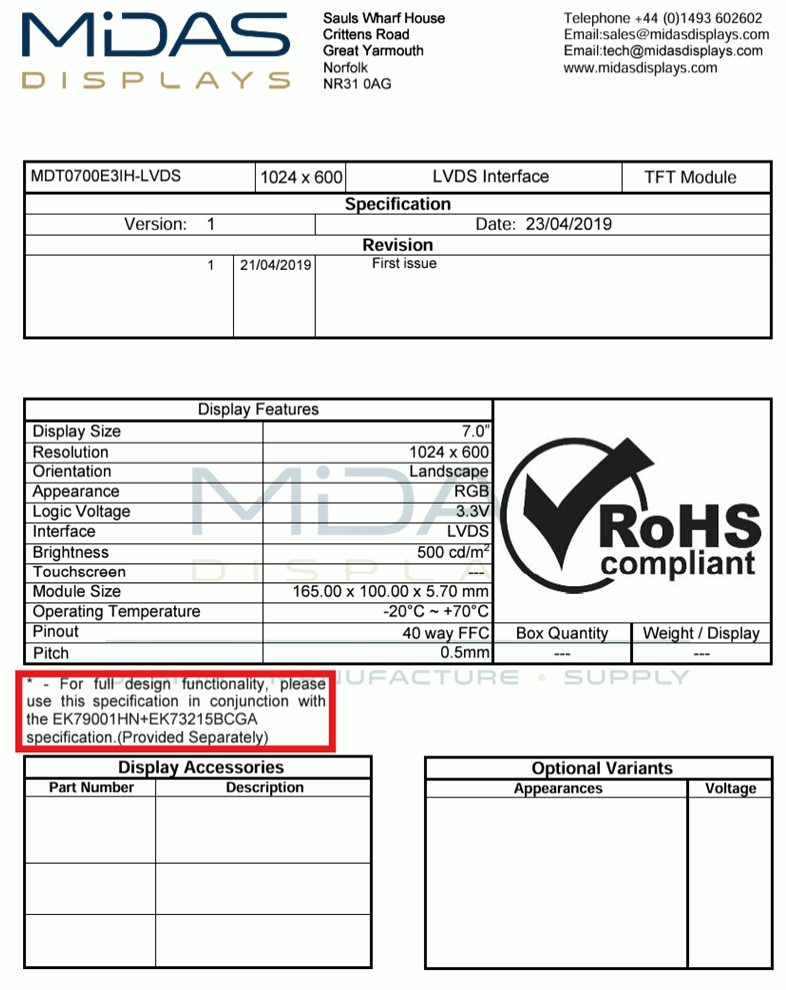
Key Formulas for Display Timing
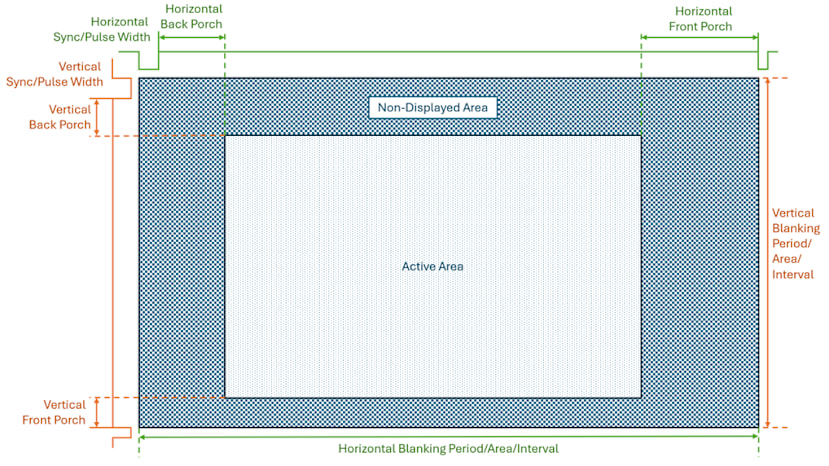
Understanding the relationships between various timing parameters is crucial:
- Vertical Blanking Period = Vertical Sync Width + Vertical Back Porch + Vertical Front Porch
- Horizontal Blanking Period = Horizontal Sync Width + Horizontal Back Porch + Horizontal Front Porch
- Vertical Total Size = Vertical Blanking Period + Active Area Height
- Horizontal Total Size = Horizontal Blanking Period + Active Area Width
- Horizontal Scan Rate = Vertical Total Size × Frame Rate
- Line Frequency = Frame Rate × Vertical Total Size
- Pixel Clock = Frame Rate × Vertical Total Size × Horizontal Total Size
Definitions of Core Display Parameters
- Video Data:
Comprises frames, which consist of lines, further divided into individual pixels. Frame Rate refers to the number of frames displayed per second. - Frame Components:
- Active Area: The visible part of the display.
- Vertical Blanking Interval: Includes Vertical Sync Width, Vertical Front Porch, and Vertical Back Porch.
- Horizontal Blanking Interval: Includes Horizontal Sync Width, Horizontal Front Porch, and Horizontal Back Porch.
- Interlaced Video:
In interlaced formats, frames are split into two fields: one containing odd lines and the other even lines. - Display Modes:
- Display Enable (DE) Mode: Identifies active video periods without blanking intervals. In this mode, the panel generates Horizontal and Vertical Sync signals.
- Sync Mode: Requires the video source to provide Horizontal and Vertical Sync signals to align video data correctly, preventing screen tearing.
- Blanking Period:
This interval occurs between lines (Horizontal Blanking) or frames (Vertical Blanking). While originally for CRT monitors, it is now reduced for LCDs.
Timing Parameters in Detail
- Horizontal Front Porch (HFP): Number of pixel clocks between the last active pixel and the next Horizontal Sync pulse.
- Horizontal Back Porch (HBP): Pixel clocks from Horizontal Sync to the first active pixel in a line.
- Horizontal Sync Width: Duration of the Horizontal Sync pulse.
- Vertical Front Porch (VFP): Number of lines between the last active line and the next Vertical Sync pulse.
- Vertical Back Porch (VBP): Lines between Vertical Sync and the first active line in a frame.
- Vertical Sync Width: Duration of the Vertical Sync pulse.
Additional Key Terms
- Active Frame Dimensions: The width (horizontal resolution) and height (vertical resolution) of the visible display area.
- Screen Width/Height: The total number of pixel clocks or lines, including blanking.
- Refresh Rate: The number of times the screen refreshes per second.
- Horizontal Scan Rate: The total number of lines scanned per second, including blanking intervals.
Comments