

Project Overview
Our Master’s Group Design Project at the University of Southampton focuses on engineering a “back-to-back” dynamometer, which will enable the evaluation of regenerative braking characteristics on electric machines. This rig previously did not exist at our University. Hence, our solution allows users to evaluate an electric vehicle architecture by considering energy efficiency to reduce their environmental impact; or enhance power output without compromising range. As a result, the dynamometer will be capable of simulating both application-specific load cycles and will enable the assessment of the required blending of mechanical and regenerative braking.
Our Systems
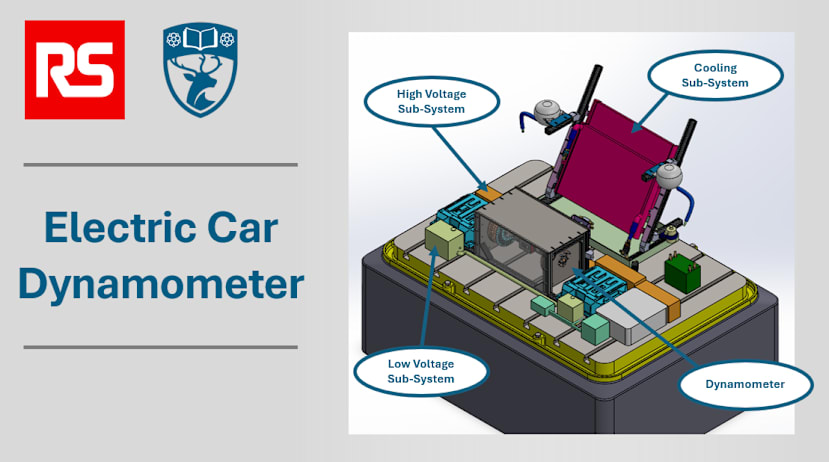
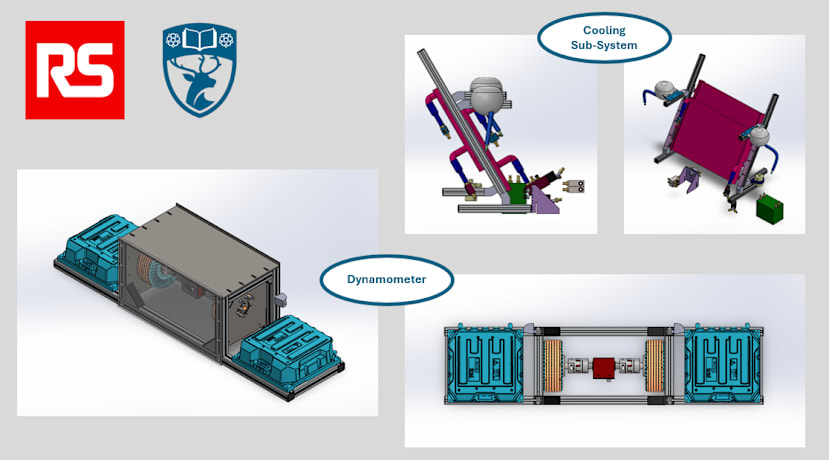
The dynamometer features a fully integrated low voltage & high voltage architecture, alongside an active cooling system used to manage thermal rejection of up to 22.65kW and overall is capable of testing machines up to 300Nm. Together, these systems will create mappings of torque, power and speed, characterising performance for both motor and generator configurations. The “back-to-back” term refers to the dynamometer's ability to recycle the energy harvested by the regenerative electric machine. This results in much lower energy usage compared to traditional dynamometers, where the “load” is generally created by water brakes or resistive heating.
RS Student Fund
RS components have been implemented throughout the rig, with parts such as adapters ensuring sufficient coolant circulation and regulation. In addition, the fuse block and connectors provided by RS have enabled us to make secure, suitably insulated connections in both the high and low voltage sub-systems to ensure operational safety.
Challenges
Throughout development, we encountered many challenges. Our primary constraint was our limited budget to produce a high-end dynamometer. We addressed this by being resourceful, participating in an Elevator Pitch and obtaining the RS Student Fund to secure additional funding.
Time was another adversary. To manage a large scope of deliverables within a short timeline, we split the project into three distinct sprint phases. We started with basic motor operation and are advancing to full regenerative capabilities with our newly designed system. This allowed us to hit critical internal deadlines without compromising quality.
One of our most significant victories was successfully running the first electric machine as a motor. This proved to be demanding, but through perseverance and attention to detail, it was successfully executed, with the motor outputting continuous, reliable motion and data.
Impact & Conclusions
Overall, the RS Student Fund has significantly reduced the impact of cost on our project and allowed us to implement quality, industrial-grade components. These high-quality components ensure rigorous safety standards are met and guarantee that the dynamometer will serve the University and students as a reliable research and teaching tool for future years.
The project has been challenging yet rewarding, and we are grateful for both the technical and soft skills we have learnt. If you are a student with the opportunity to undergo similar projects, we would strongly recommend taking on this opportunity, not just for the invaluable experience, but for the rewarding feeling of seeing your idea come alive!
Comments