

The RS Build Fund has played a major & invaluable role in enabling the development of the electrical systems based around our electric-mobility vehicles, but, in particular, the assembly of our high-voltage (HV) battery pack, which will be used to power upcoming EV projects.
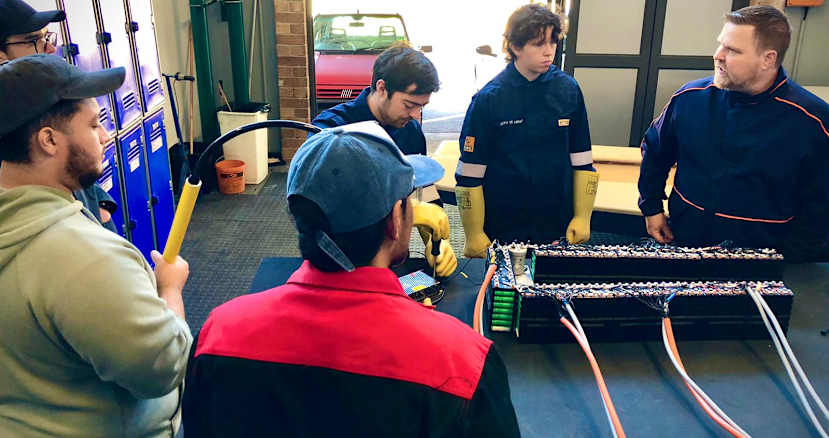
Every aspect of the design process, from the small low-voltage (LV) wiring that controls the safety system surrounding the HV battery pack, to the tools used on the HV system itself, were provided by the RS Build Fund. This has enabled us to operate safely and efficiently without the need to doubt the quality & performance of the tools & components we use.
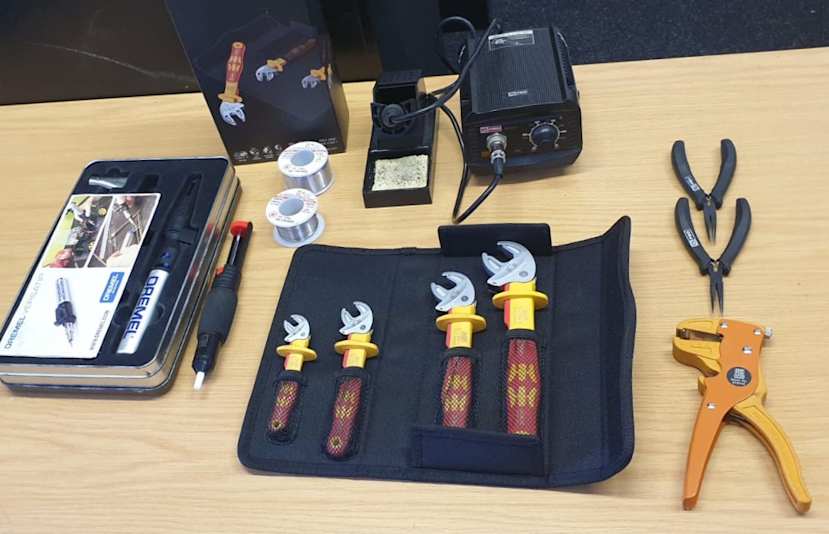
Our favourite tools are provided in the picture below. Gas-powered soldering iron, wire strippers, insulated wrenches, solder-sucker, needle-nose pliers, and a high-voltage safety hook which provides the ability for a team member to be removed from an electrical shock in the case of an emergency – particularly important when dealing with HV applications. So many more electrical components have also been sourced through RS, such as switches, cooling fans, relays, insulating heat-shrinks, high-voltage stickers, wires, emergency stops, micro-controllers, sensors and many more, which would have simply been impossible to acquire without this support.
Thanks to RS’s tremendous support, sourcing and shipping components have never been a problem, while their local support has also been without peer.
As a diverse team whose members are from different departments of engineering, cross-disciplinary learning opportunities are everywhere as Electrical, Mechanical, and Mechatronics students gain skills from each other in our projects. This enables our student team members to learn from each other in areas that are not necessarily in their specific curriculum, further enabling manufacturing processes, testing procedures or associated safety protocols. This is actively encouraged to ensure that our students are as well-equipped as possible for their future careers.
The team works well together, focusing on combining their individual strengths to further the vehicle’s development while also ensuring that each sector is well understood across the board, something that is very important in a world where young engineers are expected to know a lot more outside of just their pure disciplines. This has had the positive outcome in that everyone is always keen to jump in to provide a hand wherever necessary.
Major milestones such as connecting the high-voltage battery pack for the first time or creating the carbon floor for the vehicle tend to involve the full team, serving as a valuable learning experience for all involved. Each sector within the team is structured using a hierarchy system to ensure knowledge trickles down to ensure that every aspect of the vehicle’s design is double, or triple-checked, and that, when working with components, safety standards are upheld and each new step in the installation is verified and checked. This system also helps with facilitating knowledge exchange between team members, with open discussions, creative thinking and brainstorming sessions being a common occurrence.
This system works particularly well because all team members are students and will all eventually graduate and leave the team. By having a cross-section of students who are spread across multiple levels of engineering study from 1st Year through to Master's level, they obtain at least some exposure to all the skills required to complete projects of this nature, and this also results in continuity as our student members move on to their ultimate careers and team throughput occurs.
Another overarching issue with inexperienced students is that you can never be too safe, especially when working in HV environments, so a clear, contained workspace is crucial and adequate safety gear in the form of overalls, gloves and face shields are necessary to ensure everyone’s safety. One of the best things you can do when you are unsure about a situation is to take a step back, put your hands in your pocket and perform a visual inspection to identify any hazards, and additional HV safety protocols training has been undertaken to facilitate this.
Manufacturing also inevitably takes longer than one thinks it might, and no component is ever perfect, so you must be prepared for the inevitability of adapting the design as the situation calls for it. A complex project of this nature ensures integration of structural, electrical, electronic and IT aspects to result in a successful outcome.
In addition, the team utilises many CAD and CAE simulation platforms, and we try to ensure that team members have every opportunity to experience these at different levels of intensity.
As this is the first generation of our electric Formula Student car, many aspects of the project are also being completed from scratch which has significant challenges, but is also a great opportunity for learning, making mistakes and learning again. This iterative process is ultimately extremely worthwhile as it ensures that student team members have to analyse and trouble-shoot any challenges that may arise.
The fact that we have in-house capability of 3D printing, PCB printing, composite lay-ups and a fully equipped machine shop also gives the team much latitude to explore their ideas and produce real-world outcomes that can be installed and tested in-situ.
An example of one of the major challenges we faced was commissioning and installing the battery management system for the HV system, something we had no prior experience of. Under the guidance of local technical experts, we were able to connect most of the system and monitor a demo battery on the provided software. This has ultimately led to the build and connection of our HV pack, this following the HV safety training course, which equipped us with the skillsets necessary to safely do this.
This highlights the further benefit of exposing our student team members to external industry and private sector experts who have been very willing to assist with advice and guidance wherever necessary. Soft skills such as these types of interaction will also provide invaluable additional long-term experience as our team members move out and start making real-world contributions to the engineering discipline.
Comments