

Objectives
Estigia, the 2U CubeSat under development by Pluton UPV, will incorporate a chatbot to hold virtual conversations via text. Users on Earth will be able to chat with the satellite as it passes over their location. During the conversation, users will be able to request telemetry data from the satellite, such as temperature sensor readings, battery discharge status, flight time, and more.
The main technical mission objectives set for Estigia are described in the following list:
- To successfully complete the design, assembly, validation, and verification of a spacecraft.
- To demonstrate the capabilities of Artificial Intelligence (AI) aboard a spacecraft.
- To demonstrate the capabilities of LoRa for two-way, direct-to-satellite communications between ground terminals and a satellite.
- To develop and optimise a Large Language Model (LLM) capable of maintaining a coherent conversation with a human, as well as providing data at the user’s request.
- To design and manufacture portable LoRa-based ground terminals for the end users.
- To establish a text conversation between a user and the satellite’s chatbot. The chat interface will be provided by an application running on a smartphone connected to the aforementioned LoRa ground terminal.
- To successfully design, build, and operate a ground station which is able to communicate with Estigia, as well as other satellites and the International Space Station (ISS).
The project has several educational objectives, as described in the following list:
- To continuously train students on the development of a spacecraft, focusing on the functional analysis of subsystems, procedures, and space standards.
- To inspire space-related careers in elementary, secondary, and university students.
- To provide UPV professors and researchers with tools to expand their understanding of space missions, and to use them effectively in the classroom amongst students.
- To generate a space projects’ ecosystem at the University, in order to boost the creation of new research projects related to space technology in a variety of knowledge areas.
- Establishing relationships with the European space industry to increase the participation of external entities in future UPV’s missions.
- Acquiring the skills and resources to develop some of the facilities for a space mission.
Methodology
The Estigia satellite is currently in Phase B/C of development (this is, between preliminary and detailed design). It is very difficult to describe the stages and abilities needed to conceive, design and integrate a satellite, but we will try to explain the satellite as best as possible.
The architecture of Estigia can be divided into two main parts: the electronics stack (CubeSat Kit Bus, CSKB) and the spacecraft structure. The solar panels are mounted on the structure. The electronics stack contains all the subsystem printed circuit boards (PCBs) with the exception of the solar panels. All stack boards follow the CubeSat PC/104 form factor and use the CSKB electrical interface. The subsystems are a mix of COTS (Components-Off-The-Shelf) and in-house. The structure has been developed in-house and meets all the requirements of the CubeSat Design Specification (CDS) Revision 14. The structure is machined from Aluminium 7075.
The components of the CubeSat are distributed throughout its structure to ensure that the centre of mass is close to the geometric centre, improving stability during operation and attitude control. Interconnections between modules are arranged to minimise wiring complexity and ensure robust signal transmission. In addition, EMC and EMI considerations dictate the placement of sensitive electronics, isolating them from potential sources of interference. The thermal behaviour of the satellite has also been taken into account in the subsystems’ placement.
Regarding the payload, Estigia includes a computational module that runs a neural network, which is designed to function as a chatbot using LLMs and GPT technology. To make inferences, LLMs have to process huge amounts of data and perform highly complex calculations: this requires considerable computing power. However, Estigia has limited volume and power available, which limits the solution to low size, low power, low resource hardware. A Degree Final Thesis from a Computer Science team member has served as the starting point for the development of this payload. Upon intense conversation, the current embedded model can consume at peak as little as four watts!
The second payload consists of a LoRa gateway, a network concentrator that can serve many LoRa end-devices or terminals on Earth. In the Estigia mission, this hardware provides narrowband, low-bitrate, low-power, long-range, multiple-access, direct-to-satellite, wireless communications to chat with the onboard AI. LoRa was chosen as it provides all of the above, while having excellent receiver sensitivity and considerable robustness under low SNR, and remaining accessible and inexpensive, especially in the ground segment.
Communication between the satellite and a ground terminal will be possible thanks to an internally developed portable LoRa device connected to a smartphone. In addition, there is a traditional TT&C (Telemetry, Tracking, and Command) subsystem, which sends telemetry data and receives commands from a conventional ground station. This radio system is not available to end users.
Furthermore, AI could be useful in short-term manned space missions as a complement to existing technology, or in long-duration interplanetary missions, where humans cannot directly operate the spacecraft or traditional programming is not sufficient to meet operational requirements.
At Estigia, AI is not used for image processing, but for an everyday task, opening up a new world of possibilities in the field of the Internet of Things (IoT). In addition, AI could prove useful in short-term manned space missions as a complement to existing technology, or in long-duration interplanetary missions, where humans cannot directly operate the spacecraft or traditional programming is not sufficient to meet operational requirements.
Product
Many elements have been purchased from RS, but we will focus on some of the most important ones. They do not belong to the satellite, but instead to the Ground Support Equipment needed to develop the satellite. In our project, these facilities are pivotal and sometimes require as much work as other embedded items within the satellite.
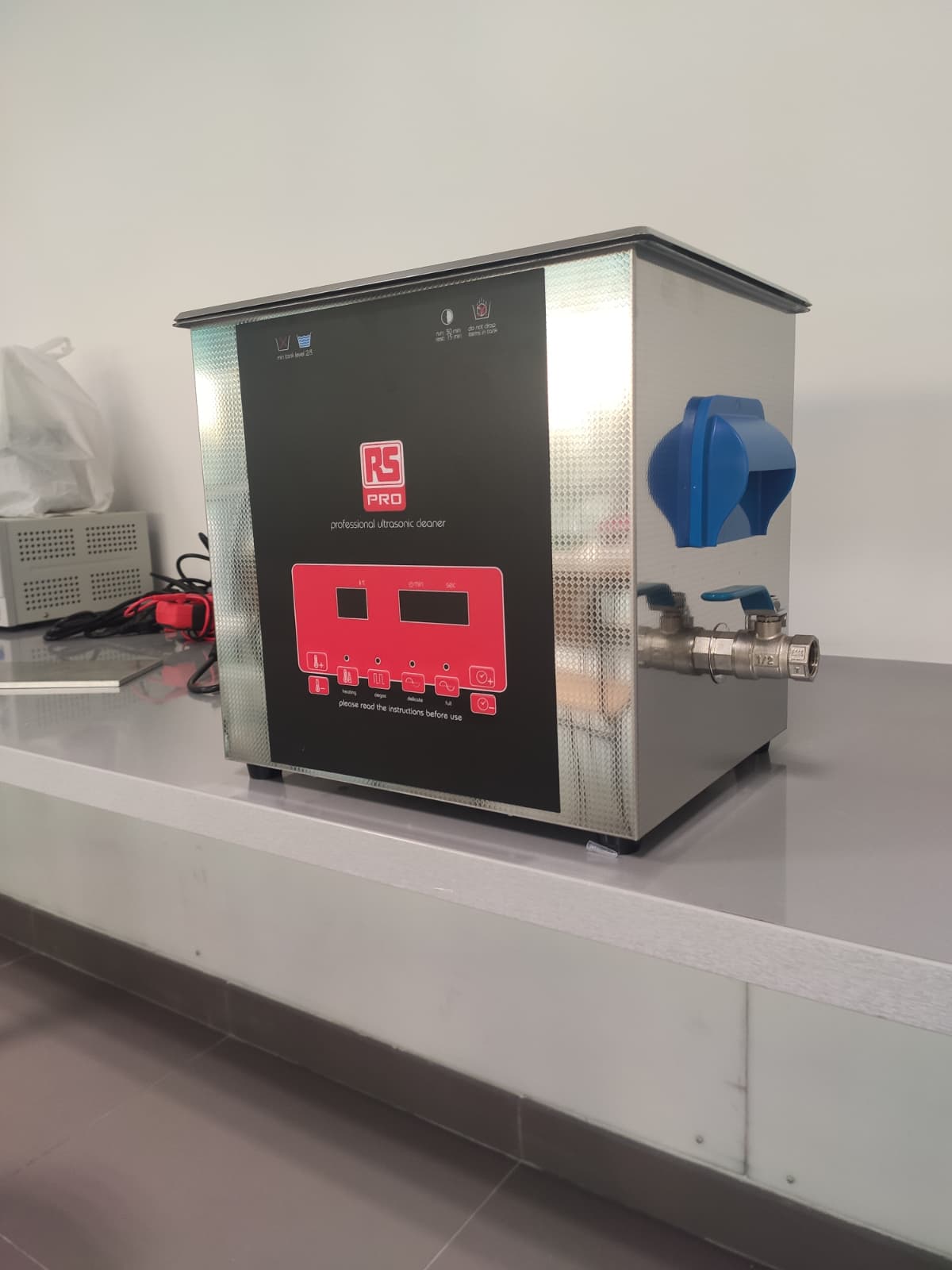
The ultrasonic cleaner (124-9722) is a pivotal element in our working space. It is an RS PRO product, it has 300 watts of power, and a volume of up to 9 litres, inside which all satellite elements can be introduced due to their relatively small size. Let’s remember a CubeSat unit is only a cube of 10-centimetres as side! The ultrasonic cleanser allows mechanical elements to be effectively cleaned before being integrated with the remainder of the satellite or being introduced in a clean environment, such as a clean box or a cleanroom.
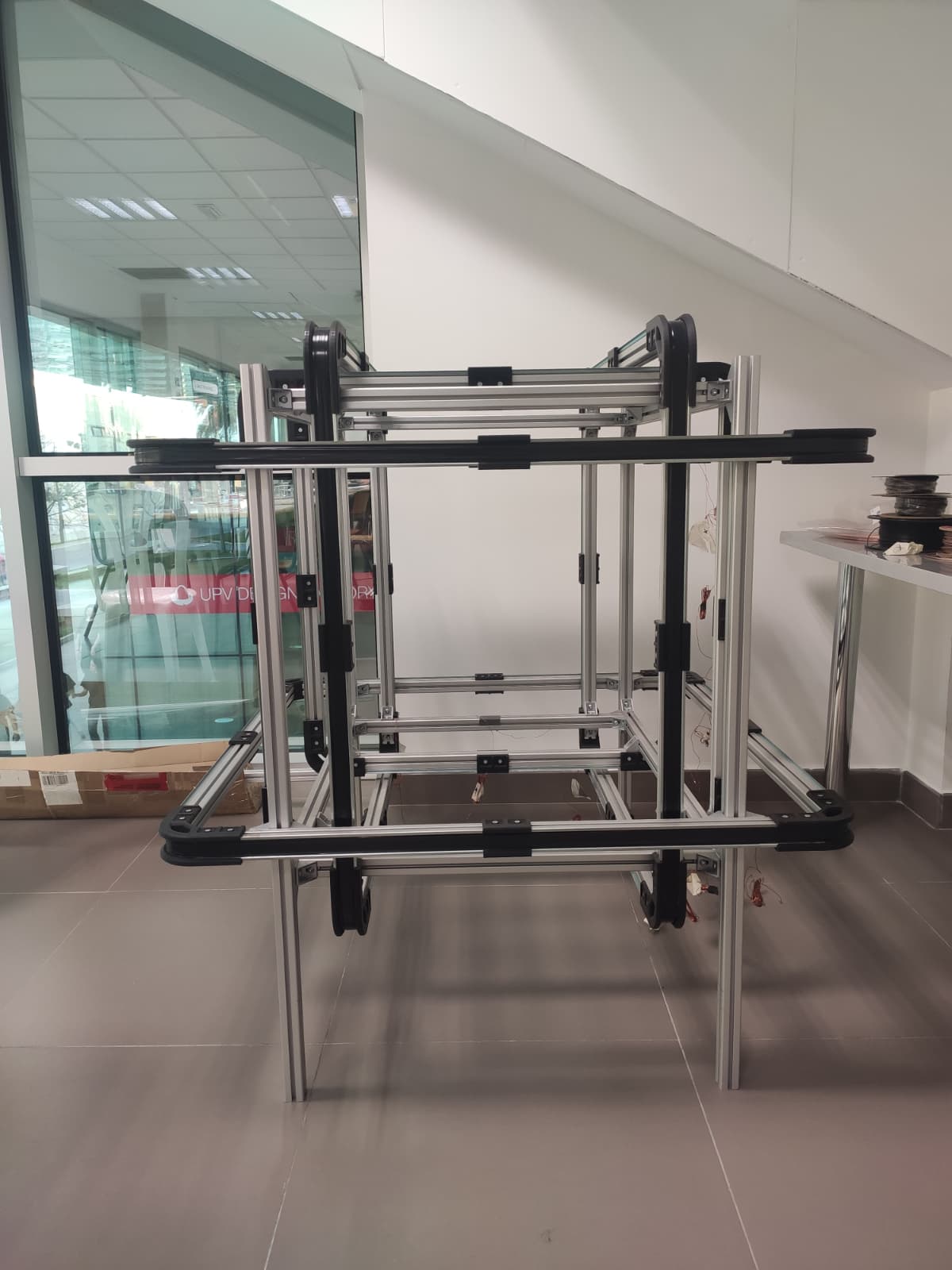
The Helmholtz cage is an electromagnetomechanical system which generates a quasi-constant magnetic field in its geometric centre. It consists of a pair of giant copper coils in each axis, upon which the passing of a current generates a magnetic field in its centre. Upon modifying the current through each pair of coils, the direction and magnitude of the magnetic centre inside the cage are changed. In turn, this allows to generate a known magnetic environment in which to test the attitude control system, which will be based on magnetic actuators.
With respect to this cage, RS has provided the aluminium frames which support the structure of the cage and the coils, as well as some tooling, screws and nuts. Furthermore, the corners are 3D-printed pieces, and its filament was also purchased through RS.
Next steps and evaluation
RS is the best provider when it comes to the purchasing process. It has millions of available products, some of which are exclusive, and it is the place to go when searching for any industrial or electronic element. Additionally, the invoicing process is automatic and seamlessly connected with our university’s economic management, making it by far the easiest online shop.
Future steps include the manufacturing, using RS products, of the central bearing of the Helmholtz cage, which will allow the satellite to physically remain in the geometric centre of the cage during the simulation sessions, allowing a frictionless motion while keeping complexity and costs low.
Pluton UPV is sponsored by the RS Project Fund
Comments