

Hello everyone.
My name is Miguel Muzás, Team Leader of Formula Gades which is the Formula Student team of the University of Cádiz. We are more than 60 teammates that work together between September and August to design, manufacture and validate a single seater to compete along Europe.
As every year, Formula Gades started this season with a main objective: get a better performance. Last year showed us that we could fight for first place provided that we improve some aspects of our car and organisation.
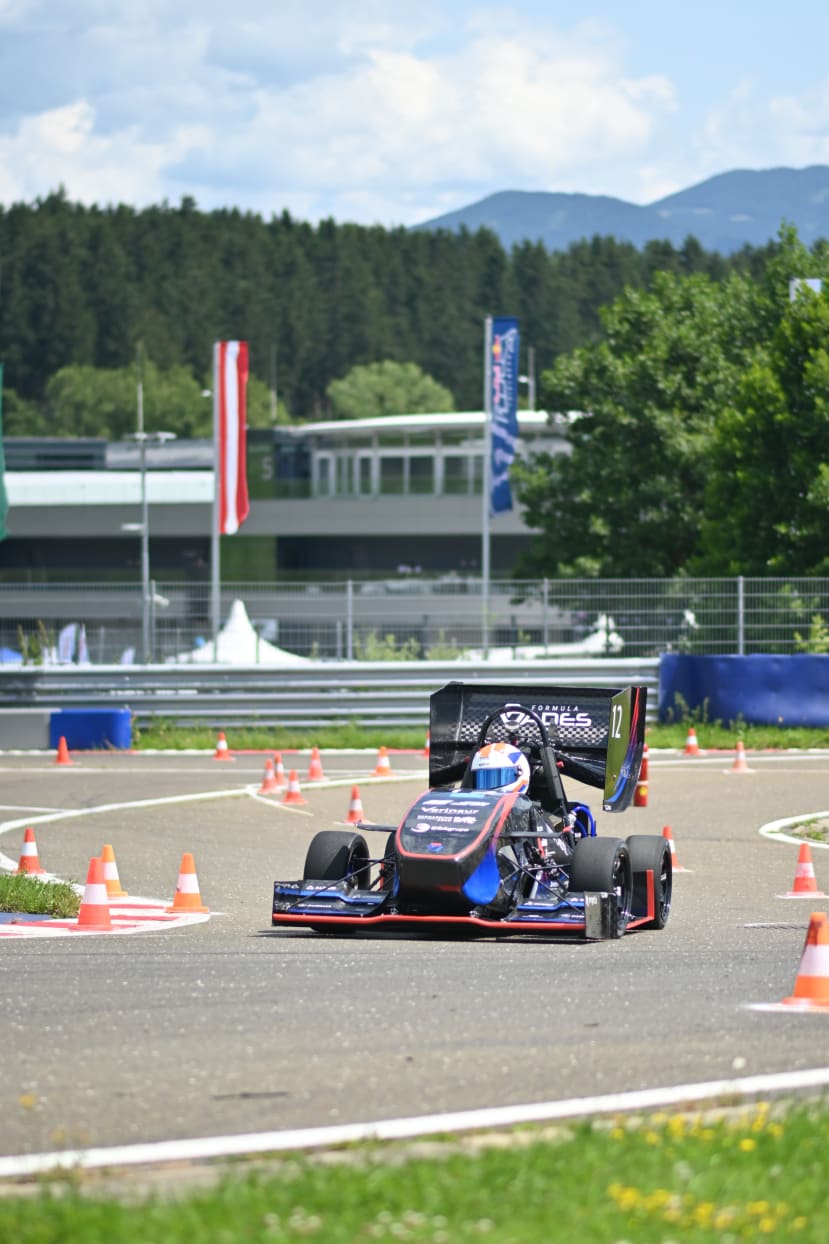
These changes began by decreasing the general weight of our G24 which is one of the most complicated tasks during the design stage due to possibility of losing stiffness. Dynamics and chassis departments must work together to not make a step back at this area. Reliability is another main point. Competitions are short so the car should be as reliable as possible because a failure could cost a lot of points on the overall.
So G24 brings some new updates compared to the last G22Evo. First of all, an optimized lighter chassis with the addition of the anti-roll bar which resolves the issues of stiffness and weight. We introduce this year a push-rod suspension system on the rear wheels. What’s more, a new complete aerodynamic package that was manufactured taking care of the whole weight, its quality and its performance on the car. Finally, powertrain improve the performance of the exhaust system and get the maximum power of our engine, and electronics deploy a new system of telemetry where data from several sensors are sent to an application at live time.
Every technical section of the team follows roughly the same work route involving design of the part in CAD, simulation and validation of it, and the manufacturing of the part. The time the team uses to divide these 3 stages of organization could be staged as:
- CAD Design: September – November
- Simulation: November – January
- Manufacturing: January – June
Following this path, the team has had a successful journey of design, simulation and manufacturing. The team sub-divides in 5 technical sections: Aerodynamics, Powertrain, Dynamics, Chassis and Electronics. Every section has various team members with their own responsibilities, designing a specific part, which is checked weekly by their two sub-team leaders. This gives freedom and room for creativity to the members which helps upgrade the design of the car, but always with a limit and guidelines given by the superiors.
The CAD design process comes along with the simulation process. While some team members are designing, others are simulating to make sure it works, to optimize material and weight and to test the break limit of the parts. This is a long process, giving as an example aerodynamics, the main difficulty that came along was the ‘try and error’ process. There are usually various simultaneous designs of parts to be simulated and then, after simulation, the team keeps one of many to be the definitive one. This takes a long time and makes it harder to make it to the deadline. Examples of this process have been the design of the new aero package, the differential carrier, brake and acceleration pedals etc. This is an example of the main improvement of last year, weight reduction and a lower center of gravity, making the car very stable and fast.
The manufacturing stage is very challenging. It depends on time, finances and possibilities of usage of machinery. A lot of parts are sent to be machined by professional companies, while others are manufactured by the team. The ones manufactured by the team are in the majority composite parts, which requires a long and costly process. The know-how of the manufacturing process comes from the wiki of information that the team uses to pass on knowledge. With the help of the info and the testing of rigidity, all the aero packages and other composite parts have been successfully manufactured with a good low weight-high rigidity ratio. For the machined parts, it all depends of the trust and good relations of the companies that work with Formula Gades to make it possible. The main challenge of this stage is the finances and time. This has been resolved with the improvement of organization and deadlines of the team, that has worked magnificently to make everything work like a clock. The finance issue has been an important one, which was resolved with the help of a good relationship with companies that help the team immensely, like RS, which has helped the team and played an important role in this season.
As every formula student team needs, there is a shared passion that promotes group union and collaboration that blends every knowledge area.
Our team is divided into six sub-sections, which are separated by domain. These are electronics, aerodynamics, engine, chassis, SDF (suspension, steering and brakes) and BAO (Business And Operations), each one having a sub-team leader. The way in which each section works is through the supervision and distribution of tasks that the sub-team leader assigns to each member belonging to it. Is the task of the sub-team leader to also make the section comfortable, motivated and informed about the other decisions.
Then there is a technical leader that brings a general vision of the entire car taking into account each individual sub-sections decision and acting as a guide. Finally, there is a team leader, that takes the responsibility to keep the team running.
For us, this dynamic has been refined to the point we are today, this makes a group of passionate students that not only learn about their own sub-section domain, but they must also comprehend the entire car concept and have knowledge about multiple areas to make working together as smooth as possible.
The organisation in the workshop contributes greatly to good work, ideally by implementing lean manufacturing. In the competition box, it is even more important to keep it tidy, the image of the box is the image of the team. it has become clear to us that, even though we are not a company, it is best to function as one. Every year we have been more demanding with the deadlines, and it has paid off.
The car has many areas, and each has many aspects to design. We have tried several ways to organize the team in the technical section, pages like Trello or Google Drive, last year we implemented a wiki, customized by us, probably the biggest advance the team has made recently. One of the points where the team has advanced the most is in the anchors, specifically those of aerodynamics. The first cars had anchors that were difficult to access and slow to mount the parts. We have innovated in the competition with buttons on the bodywork, the fastest anchorages that can be found in the market.
In the first few years, we had poor scores in the static tests. Now these tests are prepared months in advance, making periodic reviews by the department managers.
None of this would be possible without RS who supported us this current season sending us some of the material that we need. It helped us a lot because at a low-budget team, as we are, every single help counts. Thanks RS!
| Item |
| Bourns PAC18R1 Series Absolute Absolute Encoder, Gray Signal, Flatted Type, 9.5mm Shaft |
| Tesa tesa 60675 Conductive Aluminium Tape, 50mm x 50m |
| RS PRO Grey Foam Tape, 15mm x 5m, 3.2mm Thick |
| Loctite Loctite Hysol 9466 Adhesive, 50 ml |
| Linx ANT-B14-CW-QW-SMA Whip WiFi Antenna with SMA Connector, 4G (LTE) |
| Linear Motion potentiometer CP 100mm 5K |
| INA NKIB5901-XL 12mm I.D Roller Bearing, 24mm O.D |
| SKF Universal Washer For Use With Needle Roller hrust Bearing, AS 2542 |
| INA AXK2542-A/0-10 25mm I.D Needle Roller Bearing, 42mm O.D |
| SKF Lock Washer 17x25x1mm For Use With Lock Nut, MB 1 |
| RS PRO RS-660 Multimeter, 600V ac/600V dc, 10A ac/10A dc, CAT III |
| Switching regulator, input 4.75 → 36V dc, Output 3.3V dc, 2A |
| RS PRO 32-Piece HSS Tap & Die Set, M3 - M12 Taps, M3 - M12 Dies |
| Araldite Araldite 2015-1 Liquid Adhesive, 50 ml |
| RS PRO Circular Connector, 2 Contacts, Flange Mount, Socket, Female, IP67 |
| RS PRO Circular Connector, 2 Contacts, Cable Mount, Plug, Male, IP67 |
| Bourns 12 Pulse Incremental Mechanical Rotary Encoder with a 6 mm Flat Shaft (Not Indexed) |
| 3M Adhesive Transparent Reclosable Fastener, 25mm x 1.25m |
| RS PRO Analogue Soldering Station 65W, 230V 480°C |
| Alps Alpine 24 Pulse Mechanical Rotary Encoder Flat Shaft (Not Indexed), Through Hole |
| XP Power DC-DC Switching Regulator, 5V dc Output Voltage, 8 → 36V dc Input Voltage, 2A Output Current, 1 Outputs |
| RS PRO Circular Connector, 2 Contacts, Panel Mount, M20 Connector, Socket, Female, IP67 |
| RS PRO Circular Connector, 2 Contacts, Cable Mount, M20 Connector, Plug, Male, IP67 |
| RS PRO Circular Connector, 4 Contacts, Panel Mount, Plug, Male, IP67 |
| RS PRO Circular Connector, 4 Contacts, Cable Mount, M8 Connector, Socket, Female, IP67 |
Thank you for reading and we hope you have enjoyed it. Now you know a bit more about how a formula student team works. We are determined to have a year full of success and special moments.
Thank you all.
Regards.
Comments