

Introduction
The OpenFlexure project develops locally manufacturable optical devices for use in hospitals, research and schools. We have successfully deployed these devices in clinics in rural communities around the world, and different researchers have integrated our designs into their setups. For successful integration into a high school setting, simply giving the school equipment will not suffice and a partnership needs to be formed between the OpenFlexure team and the teachers we want to use our microscope. To start this relationship, I invited local high school teachers to attend a workshop where I teach them how to build and use the OpenFlexure Microscope, and I learn from them the problems we are likely to face in deploying the microscopes in a high school environment.
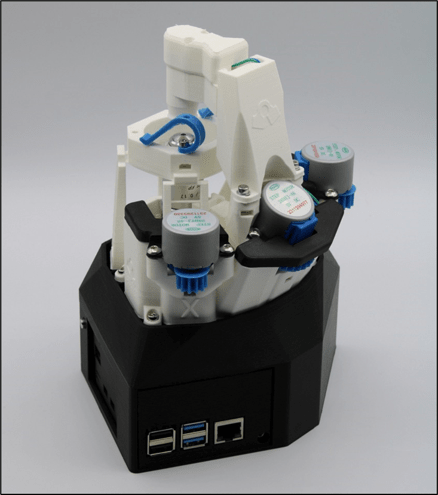
The OpenFlexure Microscope is a low-cost robotic brightfield microscope capable of high-resolution imaging. A range of different customisations are available making it adaptable to a range of environments. Powered by a Raspberry Pi and constructed using primarily 3D printed parts, it bridges the gap between hardware and software seamlessly. We believe this makes an ideal platform for interdisciplinary learning projects that could connect all STEM subjects.
While we only invited physics teachers to the first workshop, their feedback confirmed the potential for student-directed, interdisciplinary projects, allowing pupils to focus on the biology, engineering, computing or other aspects that most interested them. With a cost of parts below £300, this presents a platform within budget for many classrooms, but providing the same equipment used in research labs, undergraduate courses and hospitals.
OpenFlexure Interdisciplinary Projects
The OpenFlexure Microscope is uniquely situated at the cross-section of all STEM subjects. For biologists and chemists, the microscope offers a new and modern method of investigating any sample at a range of magnifications. When constructing the microscope, physics students constructing their own imaging device will have the opportunity to understand how the optical path of a brightfield microscope behaves. The microscope software is written in Python, which is a common language taught in high schools for pupils sitting their first exams, and comes with its own Python package to control the functionality of the entire microscope. This allows pupils to write scripts for the microscope to run. For example, a student could write a short Python script to capture images at a regular interval and create a time-lapse of a sample developing. The microscope also shows what 3D printing is capable of – something that any budding engineer would be interested in. Any school with a STEM club would have potentially an entire academic year of activities contained in one microscope.
Running the Workshop
The OpenFlexure project has run workshops in the past, but with a small team, this is not scalable. The challenge we face as a group is how do we disseminate the information about the OpenFlexure Microscope without the 6 members of the team being constantly ferried around schools and pulling focus from further developing the technology? Furthermore, we are a team of researchers, not teachers, and having educational specialists deliver lessons with the OpenFlexure Microscope would be more beneficial to students. This is where the idea for the workshop began. Instead of us going into schools, we brought the teachers to us, who could then go back to their classes of thirty or schools of thousands and run their own workshops and activities using the OpenFlexure Microscope.
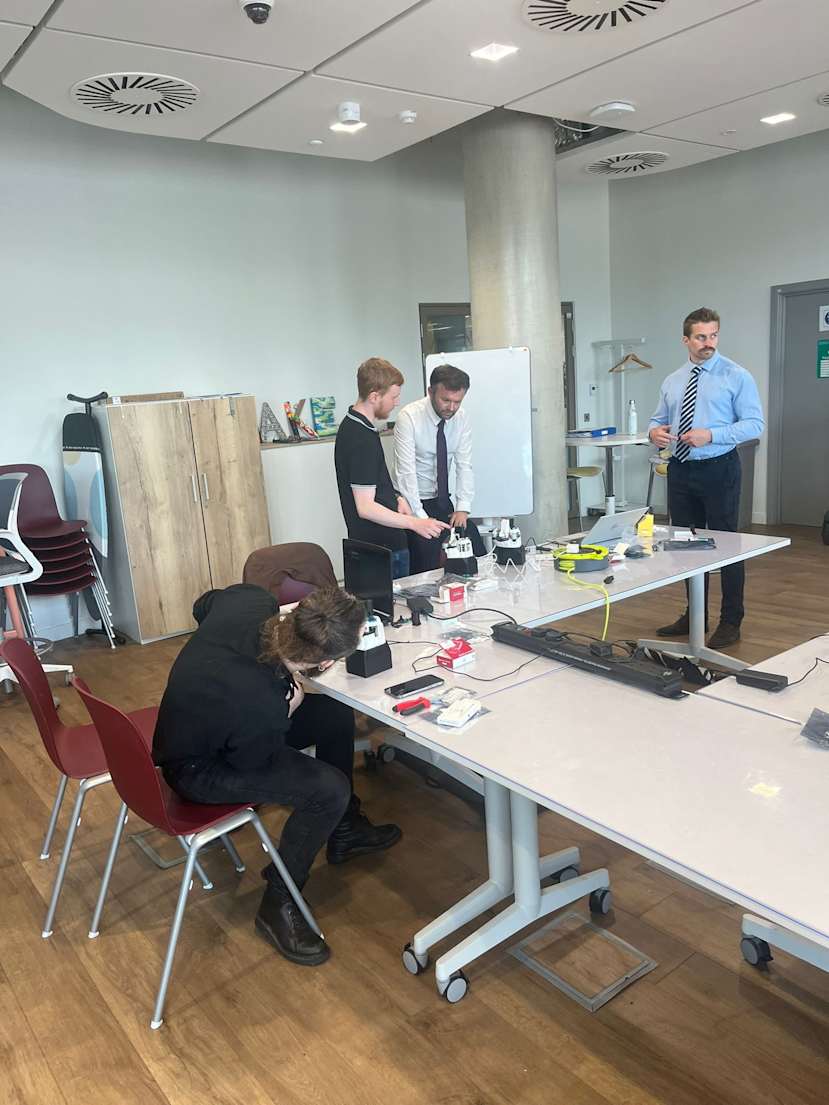
The workshop was designed to be simple, interactive and informal. I began by introducing the OpenFlexure project and was pleased to see that some of the teachers had taken the initiative and looked through our website in advance, and came prepped with questions. Once introductions were finished, we got straight into assembling the microscope. I had the instructions we provide on our website free of charge displayed on the screen, and step by step walked the teachers through building the microscope. We had 5 teachers in attendance, which meant that, with the help of another PhD student, I was able to give attention to each teacher individually to answer any questions or instruct them on more complex parts of the build. Once each teacher had assembled their microscope, I instructed them on the initial setup of the software and let them interact with the software in their own time. A small group also loaned itself well to informal conversations, which answered questions I had about STEM subjects in Scottish high schools. I had prepared a few questions, such as “Do you predict any barriers in bringing OpenFlexure microscopes into high schools?” and “What activities do you think would be suitable to run in a classroom setting with the microscope?”. In the end, I left the workshop with far more information than I expected.
I knew that simply having OpenFlexure microscopes was not enough. For a sustainable, long-term impact, understanding the needs of the teachers and pupils was required. Early in the assembly process, the teachers noted that building the microscope is not an activity they could run with their younger years, but could be done with a STEM club or sixth-year pupils. The teachers then added that having pupils aged 16-18 build the microscopes that the STEM departments in the school might use for years to come would give those pupils a sense of pride, which is otherwise hard to find in a high school setting. This allows the students to take ownership of a project with real-life implications that has an obvious impact on their high school.

Scalability was also an issue with implementing the microscope. Whilst the OpenFlexure microscope is designed to be a low-cost solution to digital brightfield microscopy, the investment from schools needed to supply enough for a classroom of 20-30 pupils is still significant – especially in more deprived schools. This is where we believe that using the microscope in senior years, where class sizes are smaller, or STEM clubs would be more suitable. The fact that it is a digital microscope poses a problem as well. Even if a school can provide enough microscopes, they then must also provide enough laptops or tablets to connect to the microscope. Some schools already have this in place, but it is never a guarantee. However, a digital microscope can be used as a classroom tool in other ways. The situation was posited that a teacher could be at the front of the classroom with a microscope plugged into their computer and displayed on the whiteboard for all 30 pupils to see at once. This gives a teacher more flexibility to look at any sample with the entire class without being limited to what is available online or in textbooks. It also gives the teacher full control over what aspects of a sample they wish the students to focus on.
Challenges and Solutions
The most challenging part of the workshop was setting up the microscopes with each teacher’s laptop. Whilst the microscopes are designed to be plug-and-play, talking them through the calibration and handling errors that occurred was difficult. During the assembly phase, I was able to stand in the middle of the U-shaped table and instruct them all at once, but once we needed to work with the software, I was dashing between each teacher, helping them one at a time. As a research group, we appreciate having the opportunity to see the parts of the software where people struggle the most, but when you are trying to show off how easy it is to use, running into problems is stressful. If the workshop was run again, I would come with an already built microscope and walk them through setting up the software step-by-step. I had intended to build a microscope during the workshop as a demonstration, but once we began the workshop, I realised it was much more useful for me to be more hands-on with the teachers.
Results and Impact
While the long-term results and impact of the project remain to be seen, it was clear that the short-term impact was significant and positive. All teachers who attended left the workshop at the end of the day with their own OpenFlexure Microscope to take with them back to their schools, and throughout the day, I was met with nothing but enthusiasm and questions. I can only wait to see if the seeds planted by this workshop bear fruit.
Indirectly, this has also given me the opportunity to build a network of education specialists who are all passionate about bringing new ideas into schools. Listening to their advice and insights into the current climate of high schools has made it clear that developing technology and infrastructure suitable for high schools can only be achieved by partnering with the teachers we want to use our microscope.
On a personal level, my passion for bringing the OpenFlexure Microscope into schools has grown. I’m now more motivated than ever to provide the tools, documentation and guidance that will make our microscope more accessible to high school students. I am also eager to repeat this workshop with another group of teachers and continue to learn new ideas and perspectives from schools across the country.
Conclusion
In preparation for this workshop, I worried that the teachers would not be engaged with the microscope or the discussion about bringing the microscope into schools. I was elated to find out how wrong I was. I hope that with such an enthusiastic group of teachers that OpenFlexure Microscopes could become the benchmark for interdisciplinary learning projects and provide an invaluable tool for the classroom. The knowledge I learned from the teachers was invaluable, and when another workshop is run, I believe I could double the number of attendees and provide an even better experience for the teachers. It is through workshops like this, with wonderfully enthusiastic teachers, that we can achieve our goal of microscopy for everyone.
OpenFlexure are supported through the RS Student Fund
Comments