

Above: 2.5min Teaser Video: Also available with Subtitles: https://youtu.be/dwPKruo9qBQ
Introduction:
Engineer and Designer, Jude Pullen, visited London and Hong Kong to explore the multi-faceted role of Repair and Fixing in society and sustainability. His 5 part series documents why they seem the perfect complement to your ethical technical career.
Although not an exhaustive survey of Repair Cafes, the immersion into ‘Repair Cafe Culture’ yields some relevant insights for Designers and Engineers to consider in their work, but also why this could be the perfect volunteering opportunity for them to explore new products, ideas and perhaps even invent something better, inspired by insights from the hands-on act of repair!
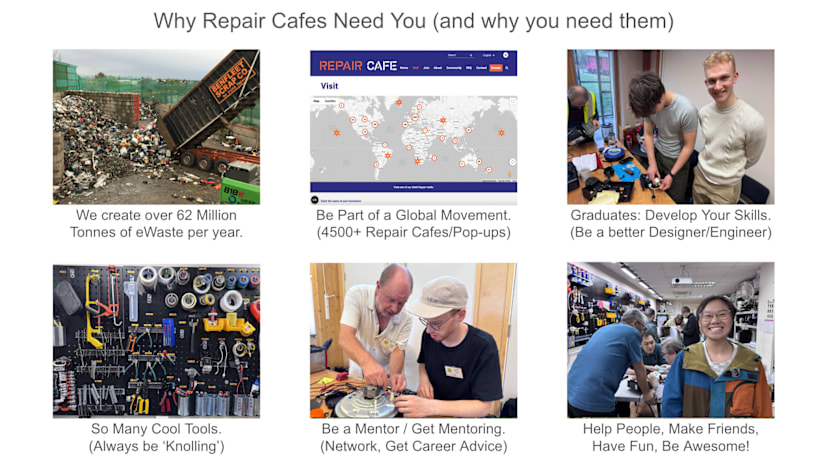
Contents:
Part 1: Repair Like Your Life (and Career) Depends On It! (below)
Confronted with shocking statistics, such as 65 million tonnes of eWaste produced in 2025, Jude explores how Repair Cafes not only repair faulty goods, but are an opportunity for Designers and Engineers to bear witness to the consequences of poor design decisions - with the hope that they will apply such ‘field notes’ to their own professional work, and that may lead to some of the changes we need as a society to have a more sustainable future.
Includes a digest of relevant EU Legislation which is reshaping our relationship with products and services, and may hopefully trigger a new wave of upgradable, repairable, ‘designed for longevity’ products.
Part 2: Why Engineers and Designers Love Volunteering at Repair Cafes. (link)
Jude references his work at Dyson, and how the ‘screws not glues’ mindset makes products better for R&D and Repair/Maintenance alike. Having also visited the UK’s largest eWaste recycling plant - where he saw products he’d designed, this was a revelation.
Part 3: Five Design Issues, Every Engineer Should Know About. (link)
After visiting a few Repair Cafes, some patterns emerge - such as the proliferation of too many Security Screws (which offer little meaningful ‘security’). A call to Designers and Engineers to ‘keep it simple’ - saving money and waste. Better design can be profitable, as well as sustainable, and is empowering to consumers to have the option.
Part 4: Twelve Things I Learned At Repair Cafes. (link)
From sponsorship tips to safety tips; Pop-up Repair Shops to cultural differences between London and Kong Kong; Geeky tools reviews; and how to engage the younger generation - Jude takes a deeper dive into the best of what Repair Cafes have to offer.
Part 5: How Did We Get Here? (link)
For those wanting a more philosophical debate on consumerism, corporate tensions, and post-collonial ethics of sustainability, Jude shares some background reading on such matters and more besides, to go beyond the ‘nuts and bolts’ and ask what this means for us as a collective, and how Repair Cafes fixes in and of themselves may not be a silver bullet, but do help us get more hands-on with the issues we need to address.
The Message: Repair Like Your Life (and Career) Depends On It!
Victor Papanek famously said, "There are professions more harmful than industrial design, but only a few" - highlighting the potential for Design and Engineering to cause harm if not approached responsibly. This was 50 years ago, in his book, Design for the Real World - and it feels only more relevant than it did then - as we are quite literally drowning in a sea of eWaste, which is the equivalent of Fast Fashion, and is rightly gaining the moniker of “Fast Tech” as we are on track to grow from around 65 million tonnes of eWaste in 2025, to a staggering 82 million tonnes of eWaste by 2030. (Even factoring in an optimistic 22% eWaste recycling effort, this is a huge problem that will not be sustainable (or even legal) for much longer - better to act now.)
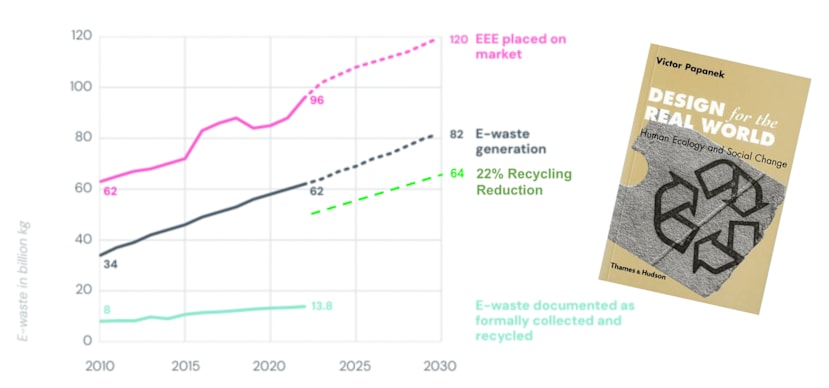
Left Image: eWaste projections (UN Report - link). Right Image: Design for the Real World.
Prevention is Better than Cure:
Repair Cafes, as good as they are, arguably are often a ‘cure’ to the ‘sickness’ of bad design decisions and short-term sales goals. In an ideal world, we’d have economic models which allowed or ‘design for longevity’ not just repair. However, one step at a time… Jude proposes that Repair Cafes are of course, a good way to ‘do something now’ - for the public and engineers to do their bit to curb worrying eWaste proliferation. But also for Engineers and Designers to use such experiences to reflect on their own work, and how to design for longevity: To consider prevention, rather than just cure, or failure in products.
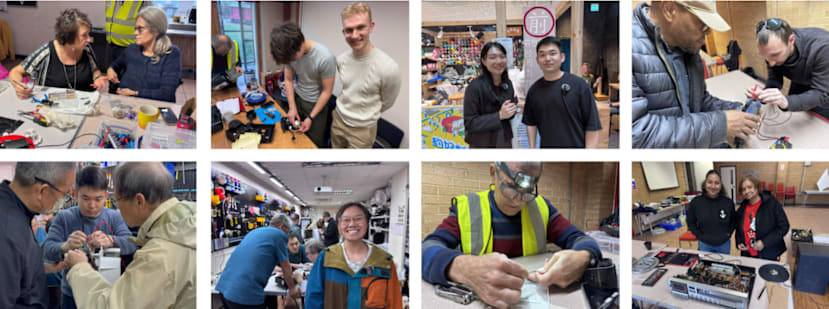
Image: Various moments in Repair Cafes from London to Hong Kong, visited by Jude in Spring 2025, as part of a journalistic series, sponsored by RS DesignSpark - more here.
Your Profession Needs You!
Few designers would be impervious to such messages of wastefulness, but in the workplace, it can feel hard to master the ‘economics of environmentalism’ - and lobby for such changes which usually do not immediately scream ‘big bonuses this year’. Repair Cafes may seem like a ‘drop in the ocean’, or critics may deride it as a slightly ‘middle-class virtue signalling activity’. However, Jude takes a different tack - to see Repair Cafes as an opportunity for enrichment - both personally and professionally, with some compelling highlights as follows:
- Mentoring: Young Engineers should volunteer, as they will likely be unofficially mentored by mid/late-career engineers, and some retirees, who have a wealth of knowledge and experience.
- The Hustle for Jobs: “It’s not just what you know, but who you know” as they say, and many young people hunting for jobs or internships stand a better chance if they know someone who’s still got connections with those companies.
- Benefit of Hindsight (or ‘Schadenfreude’): When fixing a product, most Engineers cannot help but think ‘I would do this far better’ - in which case - they should, as soon as they return to work. Nothing beats seeing the best and worst of design to motivate people to do better.
- Diversity of Products: It could be that for your day job, you design Vacuum Cleaners, but perhaps whilst fixing a mediocre Hairdryer, you realise you could do better! Repair Cafes are a horizon-widening experience for the curious and entrepreneurial engineer.
- Safe and Welcoming Community: As witnessed by Jude (and his wife) - repair cafes are reassuringly warm and unassuming places where people are made to feel welcomed to contribute however suits them best.
- Empathy and Communication Skills: Engineers largely do not love to give TED Talks, and that’s a pity, as they often have an impassioned belief in ideas, tech and innovation. Repair Cafes are a low-key way to ‘shine’, without having to be on the big stage, they are ‘king or queen for a day’ as they make someone’s day with a repair.
- Different Perspectives for Better Design: Perhaps without the pressure of work, Repair Cafes offer some of the most genuine, relaxed, and candid conversations about ease of use (aka UI/UX design). Taking time to hear that buttons are stiff, instructions are befuddling, and products are misused (through poor design / human error) is a humbling experience for Designers and Engineers to bear witness to.
- Evidence Based Lobbying: Whilst repairing (or failing to repair) a device, Engineers will naturally accumulate ‘evidence’ (photographed, videoed or memorised) of good and bad sustainable design, perhaps of competitors to their own company - and the enthusiasm to use these Case Studies and Field Notes to inspire change from within their organisation is compelling.
"In God We Trust, All Others Bring Data"
A well-known NASA saying, alluding to the mindset that even in largely religious countries like the US, Engineers are encouraged to not be purely ‘emotionally led’ and to substantiate claims. To the last point above, this is where the lone engineer can create ground-up support with ‘real-world’ examples taken from Repair Cafes.
Jude worked at Dyson, and although he does not claim the Hairdyer was inspired by a visit to a Repair Cafe, he nonetheless realises it’s an inspiring place to generate questions, create solutions, and look more holistically at modern consumer goods - hopefully towards more socially and environmentally conscious ends. He later worked at LEGO, as a Tech Scout, and Repair Cafes are a great place to see not just ‘grown up’ products, but toys in various states of dysfunction and this of course inspires innovation. Between these two corporate roles, Jude also worked for Startup, Sugru(.com) which made a ‘mouldable glue’ - perfect for fixing, so in many ways, this is a ‘return to form’ of Jude championing the notion that ‘Fixing is Fun’, and once people begin, are emboldened in their consumer choices and agency over their devices.
“Undergraduates face a Catch22 of having comparatively little experience and exposure to products, brands, and people different to them - so it is hard to find ‘real problems’ for final year projects. Repair Cafes are a ‘gold mine’ of problems - both mechanical and human - needing to be solved! Not to mention the heartfelt satisfaction of helping someone in need!
Repair Cafes are also full of more experienced people, who can offer career advice (and sometimes life advice), and it’s not implausible some insights which yield to a higher probability of gainful employment. ‘It’s who you know, not what you know’ - as they say!
For those already in an established career, Repair Cafes offer an opportunity to ‘flex’ their skills, ‘geek out’ with others who share a passion for design, and of course all these have a cumulative effect of being beneficial to one’s own career prospects. Often not far from a coffee shop or pub, who knows where the social meeting will take you, after a satisfying day of helping people, who are often in awe of your skills and competence!”
- Jude Pullen, CEng IMechE, BSc Chem.
Repair Cafes, A Brief History:
Martine Postma, a Dutch journalist with an interest in driving local-level sustainability, introduced the Repair Café [network] in Amsterdam in 2007.
“Repair Cafés are free meeting places and they’re all about repairing things (together). In the place where a Repair Café is located, you’ll find tools and materials to help you make any repairs you need. On clothes, furniture, electrical appliances, bicycles, crockery, appliances, toys, et cetera. You’ll also find expert volunteers, with repair skills in all kinds of fields”.
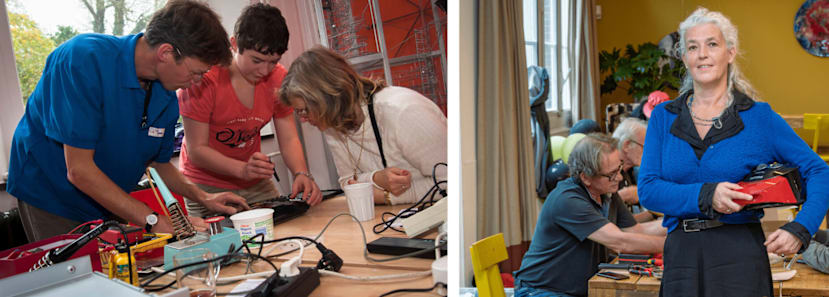
Image Credits: Repair Cafe. A repair scene (left), and founder, Martine (right).
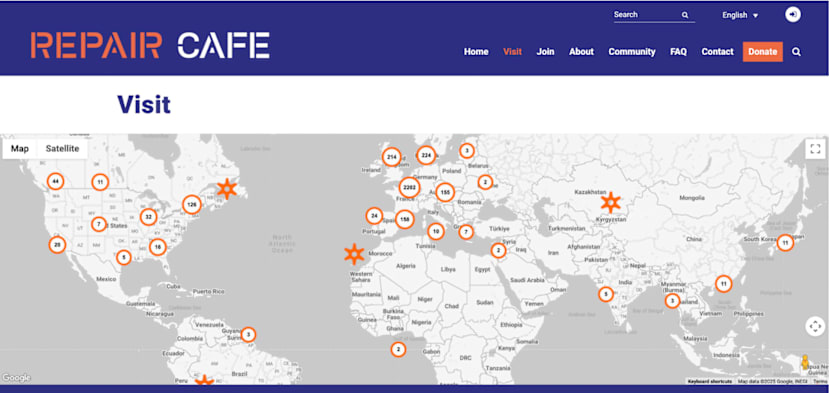
Image: A network of 3500+ Repair Cafes, (plus many hundreds more independents). Look yours up today: link.
The Hard Reality of Business.
What started out as a grassroots movement, with more associated with hackers and makers - such as iFixit Repairability Score (2009), grew with the French Repairability Index (2021), with the the European Commission now ramping-up its efforts to curtail such ‘Fast Fashion’ with updates to Directive 2009/125/EC and Regulation (EU) 2017/1369, companies should not be complacent to dismiss this as ‘virtue signalling’ or ‘greenwashing’, as there are very real consequences of non-compliance, and their corresponding fines will encroach on company profitability - such that repair by design will need to be seriously considered in business strategy. Or to put it another way - the cost of not designing to be more repairable will become more punitive to major global brands, even if you have doubts about consumers!
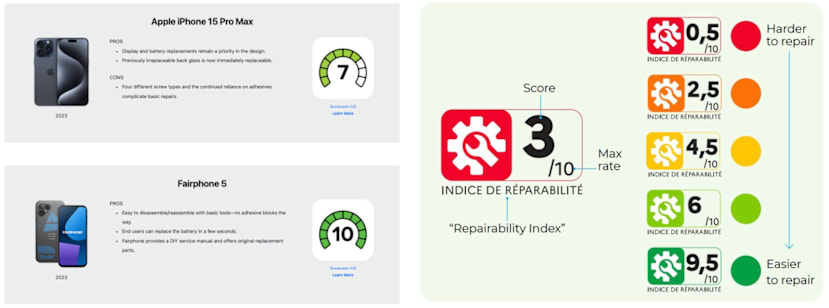
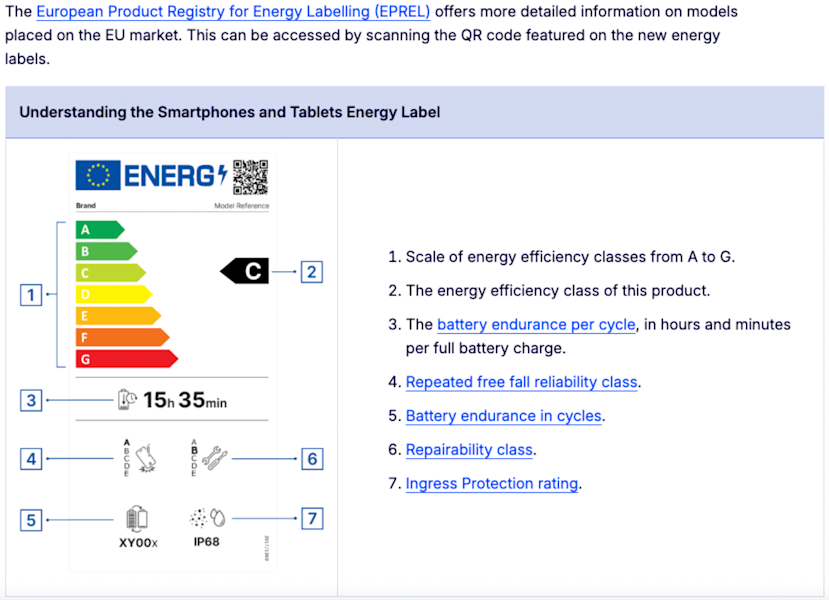
Images: Left: iFixit Repairability Score; Right: French Repairability Index;
Centre: EC Commission Directive, combined with mandatory Energy Rating.
Other examples for a multitude of consumer goods do exist on the EU Commission website, but as Smartphones have become the ‘posterchild’ of ‘fast tech’, with 5 billion devices thrown away every year, according to BackMarket, it seems fair to draw specific attention to this category, as much work needs to be done here, and the ‘trickle-down’ influence on other tech products is evident. You can search by Model or Brand - link. (or ANY products (not just smartphones) - link)
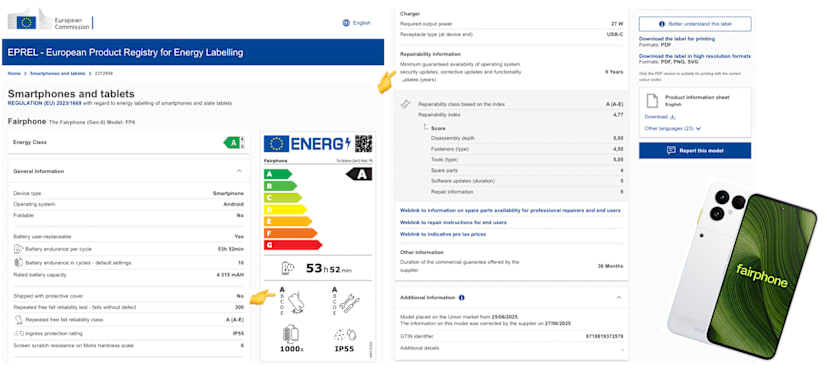
Above: Excerpts from Fairphone 6, Showing Energy Rating (A), Repairability Index (A), and Durability Index (A) - which one might assume combined is a ‘Longevity Index’ of sorts.
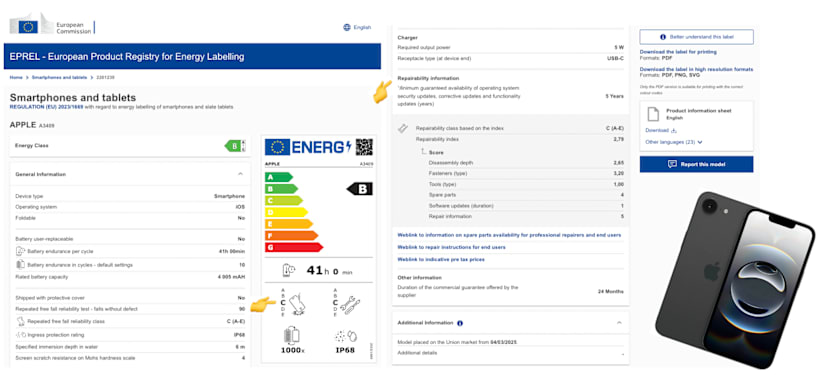
Above: Excerpts from Apple 16e, Showing Energy Rating (B), Repairability Index (C), and Durability Index (C).
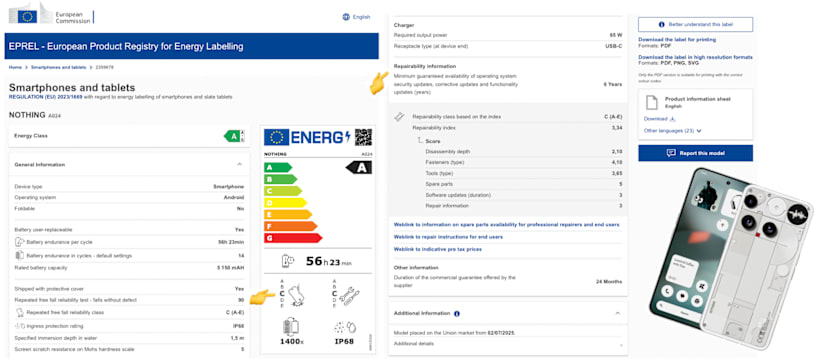
Above: Excerpts from Nothing Phone 3, Showing Energy Rating (A), Repairability Index (C), and Durability Index (C).
As many have written, the EU may be small, but it represents a large enough market that other ‘super powers’ will need to follow suit (link), and it is unlikely that leading Smartphone companies can afford to have a ‘repairable [compliant] EU smartphone’ and another similar ‘unrepairable smartphone’ - so a change is most certainly gaining traction, even if there will always be disappointing headlines of Vapes being ‘reusable’ but still unofficially marketed as single use. However, more ethical brands and products look set to engage properly. So Repair Cafes are a timely complement to a culture change in the company.
Testing a Fuse - Using Your Smartphone!.
A nice ‘party trick’ is to show that you can check a fuse (in a Mains Plug) by simply holding one end, and trying to ‘poke’/touch your phone with it. The electricity from your body will flow through the fuse if it is ‘working’, and it will do nothing if not.
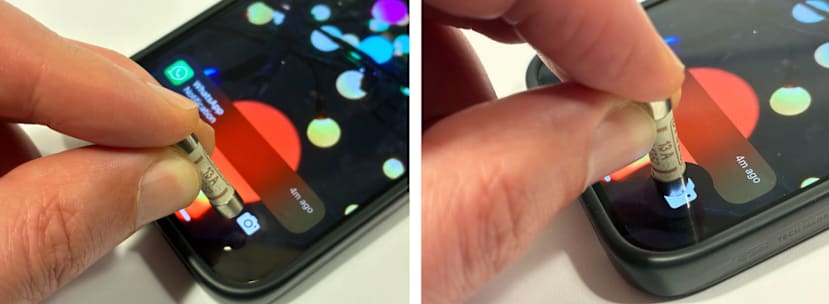
This is less complex than using a multimeter which many of the general public won’t have. It’s a nice way to remind people that Repair (and in this case diagnosing a trivial fault, and a simple ‘fix’ of changing a fuse) is easier than you might think, and doesn’t need fancy gear.
The Role of Repair Cafes in Better Design.
To recap, the role of the Repair Cafe is to complement the conscientious Designer/Engineer (or even Sales Person or Marketeer) with hands-on experience of where products fail, whether in an electronic/mechanical sense, or in a user experience (human error) - which contributes to said failures. Either way, to have more awareness of ‘prevention rather than cure’, and to foster a higher standard of ‘design for longevity’ - not just because it is the right thing to do for the planet, but because it will increasingly make sense from a profitability perspective. There is a compelling case for companies to offer Repair Cafe volunteering as part of their ‘ESG’ or ‘Social Responsibility' events (many offering a few days paid volunteering per year), and this seems a great way to create meaningful connections between consumer and company to design products which build loyalty through longevity.
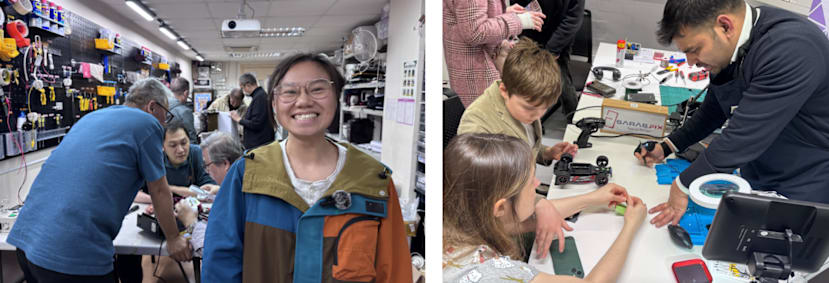
Images: Repair Cafes in Hong Kong, build community. Repair Cafes in the UK are inspiring Kids.
We have to find new ways to build relationships with products which are not purely chasing the next upgrade - if they do need updating, this does not require throwing away the entire device, but can be done at a fair price for all involved.
About Jude / Biography:

Jude Pullen is a chartered engineer, public speaker, design consultant, and award-winning communicator of technical things. With diverse experiences at Dyson, LEGO, Sugru, BBC and NHS, he has also written extensively for RS DesignSpark on how designers can be more sustainable (both environmentally and economically). His 2023 series, The Fight to Repair, has been featured in various trade magazines, podcasts and has been presented as keynotes in leading industry events. His latest investigation follows him visiting Repair Cafe Culture in London and Hong Kong (where some of his family lives) and relates the findings to helping him and others design better products for People and Planet. One of the eight featured inventors across BBC’s two Big Life Fix series, he is also a Design Expert at British Design Council, a Technologist in Residence at the Royal College of Art’s Ecological Citizen(s) team, and an enthusiastic dad.
Podcast Summary (AI Generated):
None of this has been written by AI. However, Jude has been experimenting with NotebookLM for the past year, and genuinely, it delivers good quality mini-podcast, perfect for the busy person, if the blog series is too long, or you want to listen on your commute:
Short Edit (5:53mins): https://youtu.be/HVdmBw9uK8o
Longer Edit (19:53mins): https://youtu.be/F-kDcdYEnHA
Image Info:
Reasons to be cheerful about Repair Cafes. Images, with permission, by Jude Pullen.
(High Resolution available upon request - link).
Contents:
Part 1: Repair Like Your Life (and Career) Depends On It! (link) - this page.
Part 2: Why Engineers and Designers Love Volunteering at Repair Cafes. (link)
Part 3: Five Design Issues, Every Engineer Should Know About. (link)
Part 4: Twelve Things I Learned At Repair Cafes. (link)
Part 5: How Did We Get Here? (link)
Comments